Source: Principles of Physics
Problem
A cord runs around two massless, frictionless pulleys as shown in the figure. A canister of mass $m$ hangs from the movable pulley. You exert a force $\vec{F}$ on the free end of the cord.
- What must be the magnitude of $\vec{F}$ if you are to lift the canister at a constant speed?
- To lift the canister by a height $h$, how far $d$ must you pull the free end of the cord?
- During that lift, what is the work done on the canister by the cord, $W_c$?
- During that lift, what is the work done on the canister by the gravitational force, $W_g$?
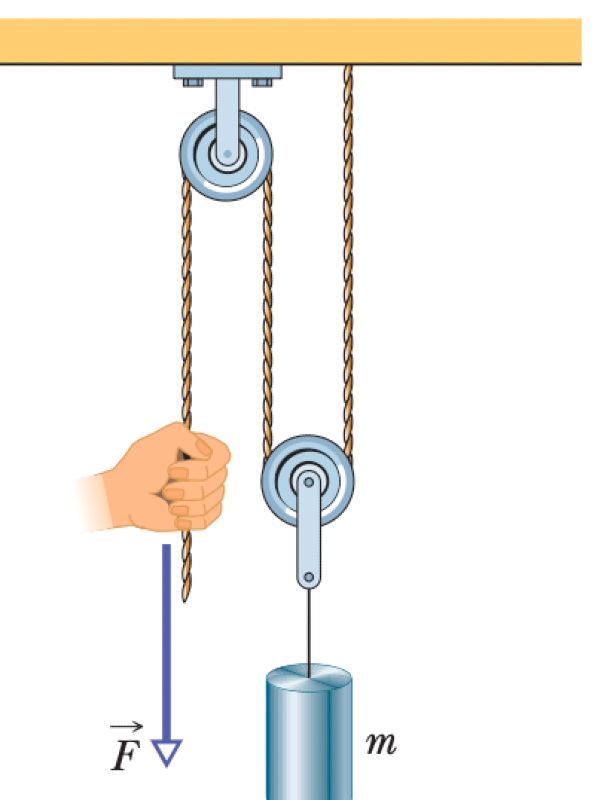
P0548-problem-1
[A1] $F = \frac{mg}{2}$ [A2] $d = 2h$ [A3] $W_c = mgh$ [A4] $W_g = -mgh$
Let $T$ be the tension in the single, continuous cord. The magnitude of the applied force is equal to the tension, $F=T$.
[Q1] To lift the canister at a constant speed, the net force on the canister and movable pulley system must be zero. Two segments of the cord pull upwards, so the total upward force is $2T$. The downward force is the weight of the canister, $mg$.
$$ \sum F_y = 2T - mg = 0 $$ $$ 2T = mg $$Since $F=T$, the required force is:
$$ F = \frac{mg}{2} $$[Q2] For the canister to be lifted by a height $h$, both supporting segments of the cord must be shortened by $h$. This length of cord must be pulled from the free end. Therefore, the distance the free end is pulled is:
$$ d = 2h $$[Q3] The total upward force exerted by the cord on the movable pulley (and thus the canister) is $2T$. From [Q1], we know $2T = mg$. The work done by this force over a displacement $h$ is:
$$ W_c = (2T) \cdot h = (mg)h = mgh $$[Q4] The gravitational force on the canister is $F_g = mg$, directed downwards. The displacement is $h$, directed upwards. The angle between the force and displacement is $180^\circ$.
$$ W_g = F_g h \cos(180^\circ) = (mg)h(-1) = -mgh $$