Source: Principles of Physics
Problem Sets:
Problem
A boy is initially seated on the top of a frictionless hemispherical ice mound of radius $R$. He begins to slide down the ice with a negligible initial speed.
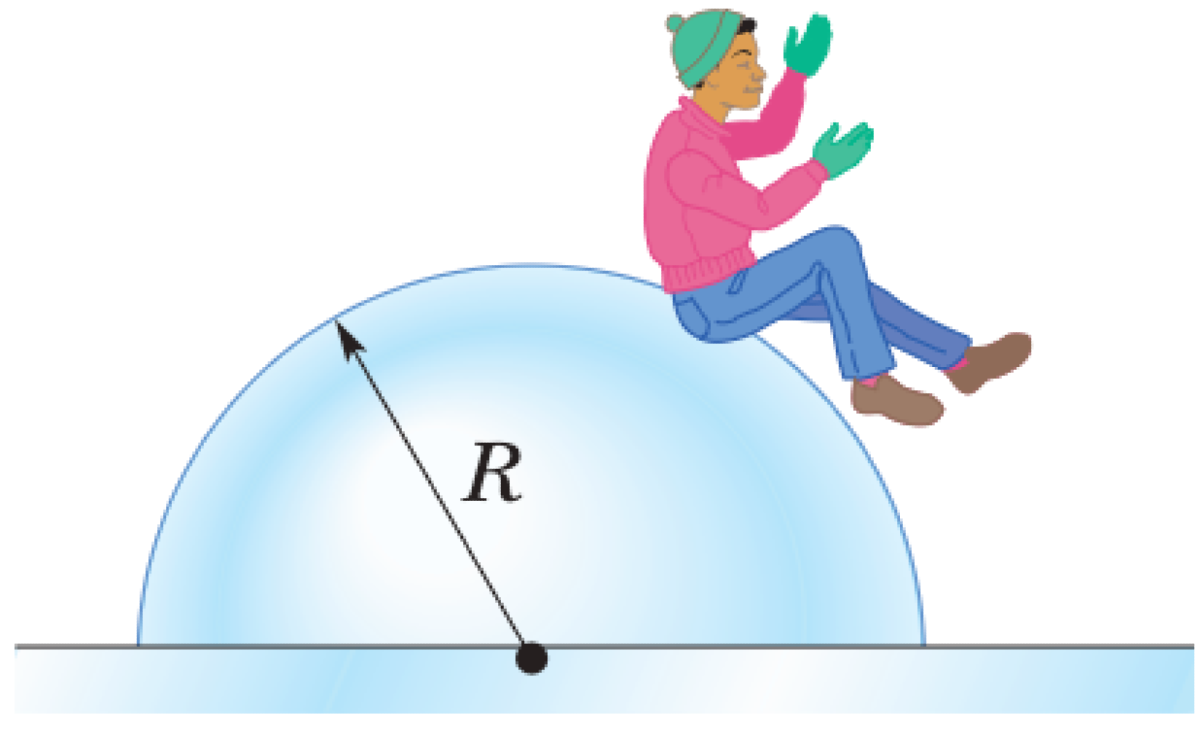
P0539-problem-1
[Q1] $h = \frac{2}{3}R$
Let $\phi$ be the angle the boy's position makes with the vertical. The boy's height from the base is $h=R\cos\phi$.
First, we use conservation of energy from the top (initial state, $h_i=R, v_i=0$) to the point of losing contact (final state, $h_f=h, v_f=v$). Let the base be the zero potential energy level.
$$E_i = E_f \implies mgR = \frac{1}{2}mv^2 + mgh$$ $$v^2 = 2g(R-h)$$Next, we analyze the forces at the point where the boy loses contact. The normal force $N$ becomes zero. The radial component of gravity, $mg\cos\phi = mg(h/R)$, provides the centripetal force.
$$F_{net, radial} = \frac{mv^2}{R}$$ $$mg\cos\phi - N = \frac{mv^2}{R}$$Setting $N=0$ and substituting $\cos\phi = h/R$:
$$mg\frac{h}{R} = \frac{mv^2}{R} \implies v^2 = gh$$Now, we equate the two expressions for $v^2$:
$$2g(R-h) = gh$$ $$2R - 2h = h$$ $$3h = 2R$$ $$h = \frac{2}{3}R$$