Source: Principles of Physics
Problem
A block of mass $m = 12$ kg is released from rest on a frictionless incline of angle $\theta = 30^\circ$. Below the block is a spring that can be compressed 2.0 cm by a force of 270 N. The block momentarily stops when it compresses the spring by 5.5 cm.
- How far does the block move down the incline from its rest position to this stopping point?
- What is the speed of the block just as it touches the spring?
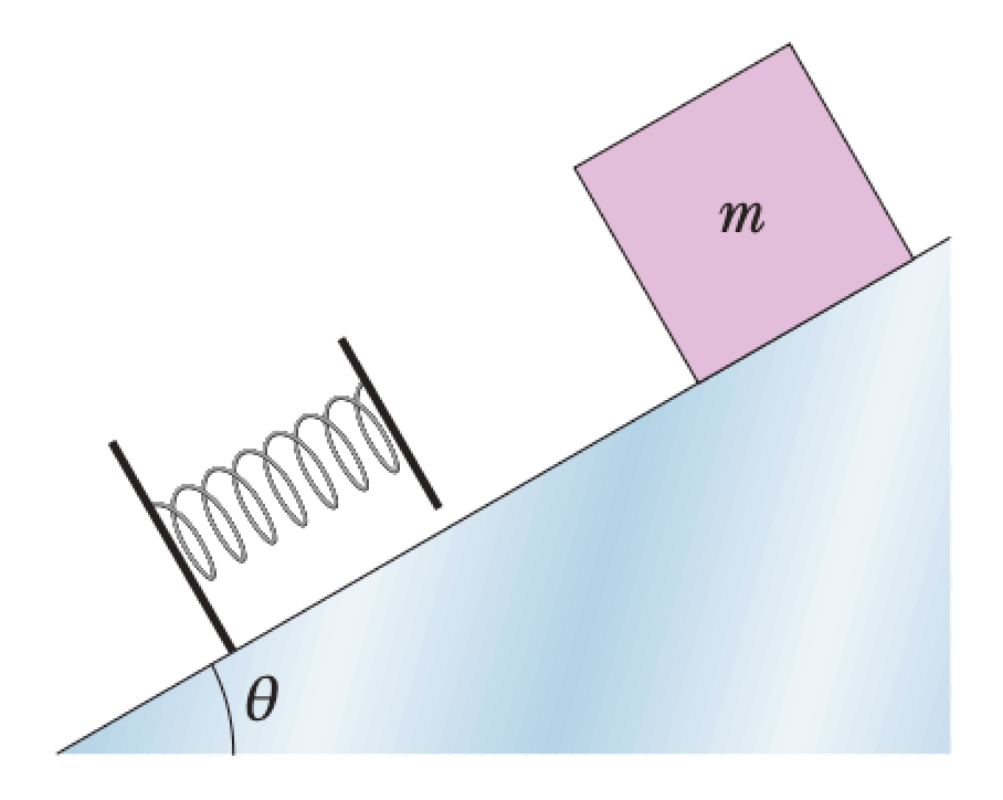
P0528-problem-1
[Q1] D = 0.35 m [Q2] v = 1.7 m/s
First, calculate the spring constant $k$ from the given data:
$$ k = \frac{F}{\Delta x} = \frac{270 \text{ N}}{0.020 \text{ m}} = 13500 \text{ N/m} $$We use the principle of conservation of mechanical energy. Let the point of maximum compression be the reference for zero gravitational potential energy ($h=0$).
[Q1] Let $D$ be the total distance the block moves down the incline. The initial state is the block at rest at height $h_i = D \sin\theta$. The final state is the block at rest ($h_f = 0$) with the spring compressed by $x = 0.055$ m. Initial energy $E_i = U_g = mgD\sin\theta$. Final energy $E_f = U_s = \frac{1}{2}kx^2$.
$$ mgD\sin\theta = \frac{1}{2}kx^2 $$ $$ D = \frac{kx^2}{2mg\sin\theta} = \frac{(13500 \text{ N/m})(0.055 \text{ m})^2}{2(12 \text{ kg})(9.8 \text{ m/s}^2)\sin(30^\circ)} $$[Q2] Let $v$ be the speed of the block just as it touches the spring. We apply energy conservation between the point of contact and the point of maximum compression. At contact, the height is $h_{contact} = x \sin\theta$ and the energy is $E_{contact} = \frac{1}{2}mv^2 + mgx\sin\theta$. At maximum compression, the energy is $E_{final} = \frac{1}{2}kx^2$.
$$ \frac{1}{2}mv^2 + mgx\sin\theta = \frac{1}{2}kx^2 $$ $$ v = \sqrt{\frac{kx^2 - 2mgx\sin\theta}{m}} = \sqrt{\frac{(13500)(0.055)^2 - 2(12)(9.8)(0.055)\sin(30^\circ)}{12}} $$