Source: Physics Competition - Mechanics
Problem Sets:
Problem
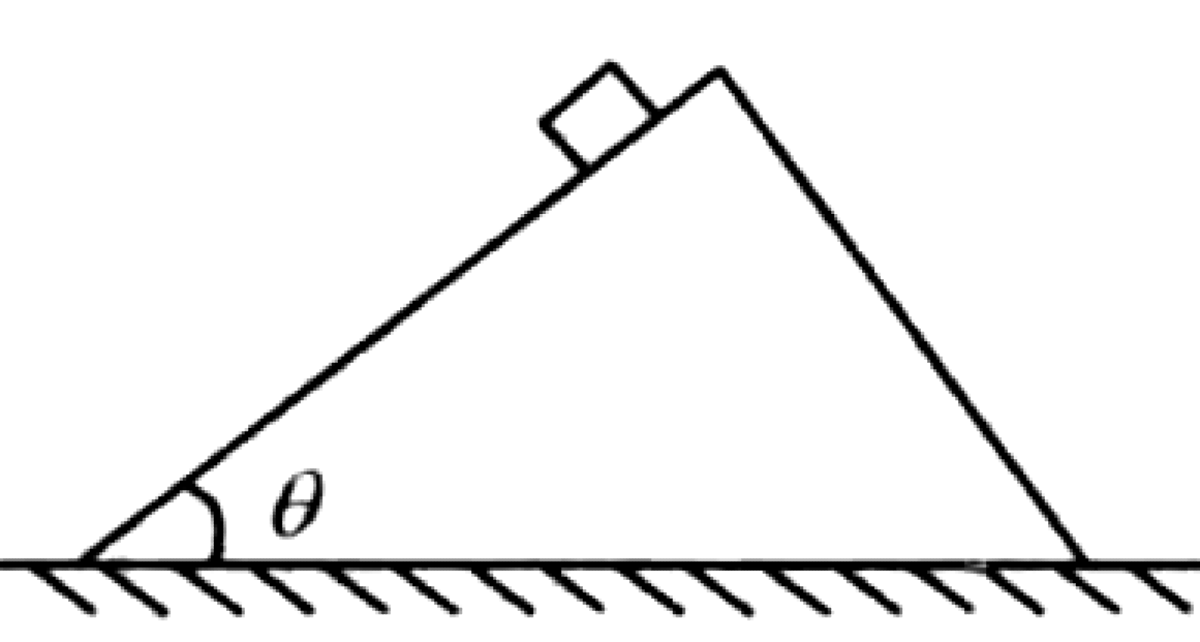
A wedge of inclination angle $\theta$ and mass $m$ is placed on a horizontal table. An object, also of mass $m$, is placed on the inclined surface of the wedge. The coefficient of friction between the object and the wedge, and between the wedge and the table, is $\mu$.
- If the wedge is not to move backward as the object slides down, what relationship must $\mu$ and $\theta$ satisfy?
- If $\mu = 1/5$, what is the range of the angle $\theta$ that satisfies the above relationship?

P0495-problem-2
[Q1] $$\cos\theta\sin\theta (1 - \mu^2) \le \mu(2\cos^2\theta + 1)$$, under the condition that $\tan\theta > \mu$. [Q2] $\frac{1}{5} < \tan\theta \le \frac{1}{5}(12 - \sqrt{69})$.
Let the object be body 1 and the wedge be body 2. Both have mass $m$. For the wedge to remain stationary, we analyze the forces acting on it. The object exerts a normal force $N_1$ and a kinetic friction force $f_1$ on the wedge.
First, consider the forces on the object (body 1), assuming the wedge is stationary. Perpendicular to the incline:
$$N_1 = mg\cos\theta$$As the object slides down, the kinetic friction force on it is $f_1 = \mu N_1 = \mu mg\cos\theta$, directed up the incline.
By Newton's third law, the object exerts a force $N_1$ (perpendicularly into the wedge) and a force $f_1$ (down the incline) on the wedge. The total horizontal force pushing the wedge is:
$$F_h = N_1\sin\theta - f_1\cos\theta = mg\cos\theta\sin\theta - (\mu mg\cos\theta)\cos\theta = mg\cos\theta(\sin\theta - \mu\cos\theta)$$The total vertical downward force on the table is the weight of the wedge plus the vertical components of the forces from the object:
$$F_v = mg + N_1\cos\theta + f_1\sin\theta = mg + mg\cos^2\theta + \mu mg\cos\theta\sin\theta$$The normal force from the table on the wedge is $N_2 = F_v$. The maximum static friction force the table can provide is $f_{2,max} = \mu N_2$.
For the wedge to not move, the horizontal push must be less than or equal to the maximum static friction:
$$F_h \le f_{2,max} \implies F_h \le \mu N_2$$ $$mg\cos\theta(\sin\theta - \mu\cos\theta) \le \mu(mg + mg\cos^2\theta + \mu mg\cos\theta\sin\theta)$$ $$\cos\theta\sin\theta - \mu\cos^2\theta \le \mu + \mu\cos^2\theta + \mu^2\cos\theta\sin\theta$$ $$\cos\theta\sin\theta (1 - \mu^2) \le \mu(2\cos^2\theta + 1)$$For the object to slide in the first place, the component of gravity along the incline must exceed static friction:
$$mg\sin\theta > \mu N_1 = \mu mg\cos\theta \implies \tan\theta > \mu$$For Q2, we substitute $\mu = 1/5$: The condition for sliding is $\tan\theta > 1/5$. Divide both side of the inequality by $\cos^2\theta$, we have
$$(1 - \mu^2) \tan\theta \le \mu(\tan^2\theta + 3)$$ $$\tan^2\theta - \frac{24}{5}\tan\theta + 3 \ge 0$$So,
$$\tan\theta \ge \frac{1}{5}(12 + \sqrt{69})$$or $$\tan\theta \ge \frac{1}{5}(12 - \sqrt{69})$$ Considering $\tan\theta > 1/5$, This gives the range: $\frac{1}{5} < \tan\theta \le \frac{1}{5}(12 - \sqrt{69})$.