Source: Physics Competition - Mechanics
Problem Sets:
Problem
As shown in the figure, two books, A and B, are interleaved page by page. The coefficient of static friction between pages is $\mu = 0.3$. The mass of each page is $m = 5$ g, and each book has $N=200$ pages. Book A is held stationary. A horizontal force $F$ is applied to pull out book B.
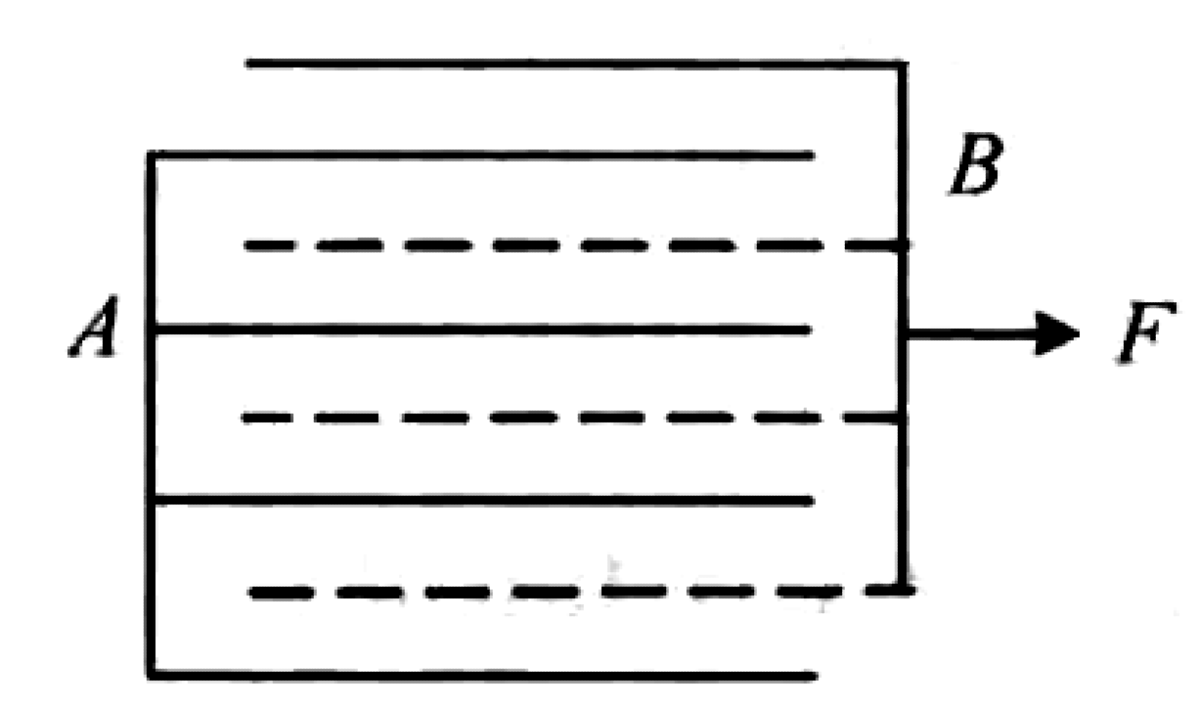
P0494-problem-1
F = 1173.06 N
The minimum force $F$ must overcome the total static friction force from all sliding interfaces. The two books have a total of $2N=400$ pages. This creates $2N-1=399$ interfaces between pages.
Let's number the pages from top to bottom, from $k=1$ to $400$. The normal force $N_k$ at the interface below the $k$-th page is equal to the weight of the $k$ pages above it.
$$N_k = k \cdot mg$$The maximum static friction force at this interface is:
$$f_k = \mu N_k = \mu k mg$$The total friction force is the sum of the friction forces at all $2N-1$ interfaces.
$$F = \sum_{k=1}^{2N-1} f_k = \sum_{k=1}^{2N-1} \mu k mg = \mu mg \sum_{k=1}^{2N-1} k$$Using the formula for the sum of an arithmetic series, $\sum_{k=1}^{n} k = \frac{n(n+1)}{2}$, with $n = 2N-1$:
$$F = \mu mg \frac{(2N-1)(2N-1+1)}{2} = \mu mg \frac{(2N-1)(2N)}{2} = \mu mg N(2N-1)$$Substituting the given values, with $m = 5 \text{ g} = 0.005 \text{ kg}$ and $g = 9.8 \text{ m/s}^2$:
$$F = (0.3)(0.005 \text{ kg})(9.8 \text{ m/s}^2)(200)(2 \cdot 200 - 1)$$ $$F = (0.0147 \text{ N})(200)(399) = 1173.06 \text{ N}$$