Source: High school physics (Chinese)
Problem Sets:
Problem
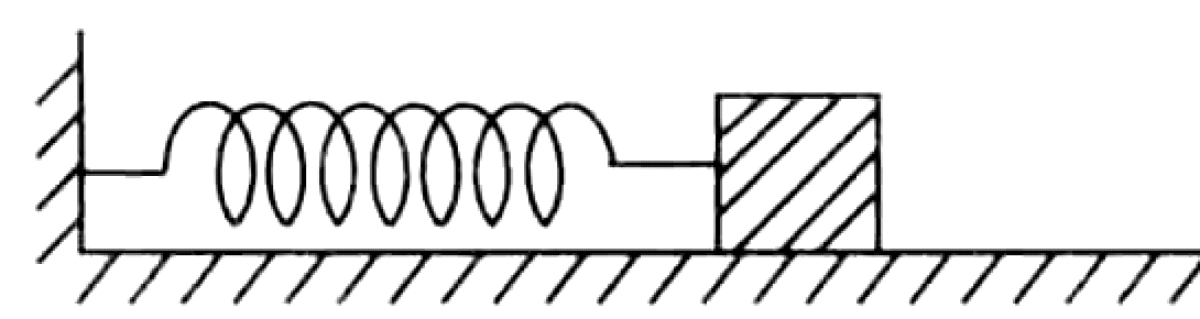
As shown, a block of mass $m$ is on a horizontal surface with a coefficient of kinetic friction $\mu_k$. It is pushed by a compressed spring with spring constant $k$. After leaving the spring (at the spring's equilibrium position), the block slides a distance $d$ before stopping.
- What is the object's maximum kinetic energy?
- What was the initial compression length of the spring?
P0486-problem-1
[Q1] $K_{max} = \mu_k mgd$ [Q2] $x = \frac{\mu_k mg + \sqrt{(\mu_k mg)^2 + 2k\mu_k mgd}}{k}$
Let the point where the block leaves the spring be the point of maximum kinetic energy, $K_{max}$.
[Q1] We apply the work-energy theorem to the block's motion after it leaves the spring. The only non-conservative force is friction, $f_k = \mu_k N = \mu_k mg$. The work done by friction over the distance $d$ brings the block to rest.
$$W_f = \Delta K$$ $$-\mu_k mg d = K_{final} - K_{initial} = 0 - K_{max}$$ $$K_{max} = \mu_k mgd$$[Q2] Now consider the process from the initial compressed state (compression $x$) until the block leaves the spring. The change in mechanical energy is equal to the work done by non-conservative forces (friction).
$$W_{nc} = \Delta E_{mech} = (K_{final} + U_{s,final}) - (K_{initial} + U_{s,initial})$$The work done by friction during this phase is $W_{nc} = W_f = -\mu_k mg x$. The initial state has $K_{initial} = 0$ and potential energy $U_{s,initial} = \frac{1}{2}kx^2$. The final state has $K_{final} = K_{max}$ and potential energy $U_{s,final} = 0$.
$$-\mu_k mg x = K_{max} - \frac{1}{2}kx^2$$Substituting the expression for $K_{max}$:
$$-\mu_k mg x = \mu_k mgd - \frac{1}{2}kx^2$$Rearranging into a quadratic equation for $x$:
$$\frac{1}{2}kx^2 - \mu_k mg x - \mu_k mgd = 0$$Using the quadratic formula and taking the physically meaningful positive root for compression:
$$x = \frac{\mu_k mg + \sqrt{(\mu_k mg)^2 - 4(\frac{1}{2}k)(-\mu_k mgd)}}{k}$$ $$x = \frac{\mu_k mg + \sqrt{(\mu_k mg)^2 + 2k\mu_k mgd}}{k}$$