Source: High school physics (Chinese)
Problem
As shown in the figure, a small object slides along a track that is curved up at both ends and has a flat middle section. The length of the flat section is 2.0 m. The curved parts are frictionless, and the coefficient of kinetic friction on the flat part is 0.20. The object is released from rest at point A, which is at a height $h = 1.0$ m above the flat section.
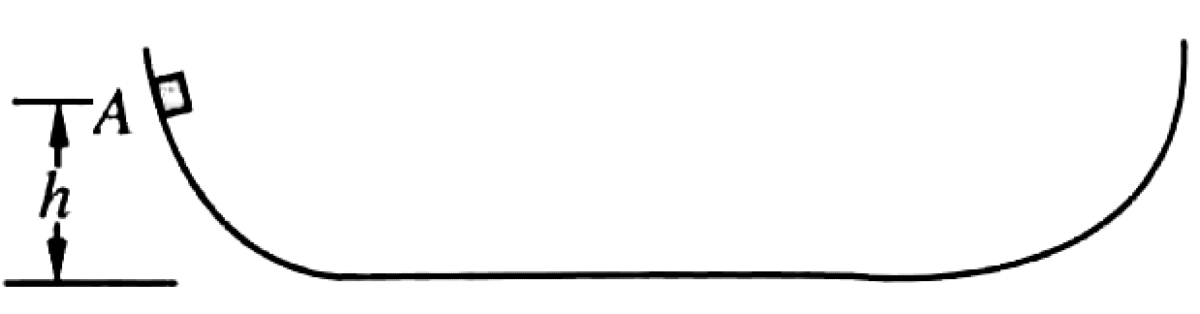
P0472-problem-1
The object will stop at the midpoint of the flat section.
The initial potential energy of the object is converted into kinetic energy and then dissipated by the work done by friction on the flat part of the track. We can use the work-energy theorem over the entire motion.
Let $d$ be the total distance the object travels on the flat section. The work done by friction is $W_f = -\mu_k mgd$. The change in mechanical energy is $\Delta E = E_f - E_i = 0 - mgh$.
According to the work-energy theorem, $\Delta E = W_f$:
$$-mgh = -\mu_k mgd$$ $$d = \frac{h}{\mu_k}$$Substituting the given values:
$$d = \frac{1.0 \text{ m}}{0.20} = 5.0 \text{ m}$$The object travels along the 2.0 m flat section. 1st pass: travels 2.0 m. Remaining distance to travel is $5.0 - 2.0 = 3.0$ m. 2nd pass (reverse direction): travels 2.0 m. Remaining distance is $3.0 - 2.0 = 1.0$ m. 3rd pass: travels 1.0 m and stops. This stopping point is 1.0 m from the start of its third pass, which is the midpoint of the flat section.