Source: High school physics (Chinese)
Problem Sets:
Problem
A block weighing 22 N is held at rest against a vertical wall by a horizontal force $\vec{F}$ of magnitude 60 N. The coefficient of static friction between the wall and the block is 0.55, and the coefficient of kinetic friction between them is 0.38. In six experiments, a second force $\vec{P}$ is applied to the block, directed parallel to the wall.
- In each experiment, what is the magnitude of the frictional force on the block? The experiments are: (a) $P = 34$ N, up; (b) $P = 12$ N, up; (c) $P = 48$ N, up; (d) $P = 62$ N, up; (e) $P = 10$ N, down; and (f) $P = 18$ N, down.
- In which case(s) does the block move up the wall?
- In which case(s) does the block move down the wall?
- In which case(s) is the frictional force directed down the wall?
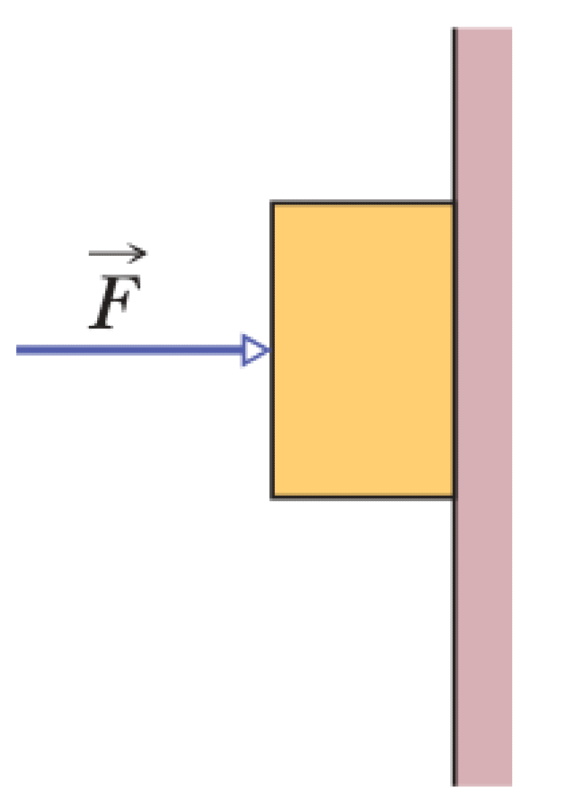
P0438-problem-1
[Q1] (a) $f = 12$ N, (b) $f = 10$ N, (c) $f = 26$ N, (d) $f = 22.8$ N, (e) $f = 32$ N, (f) $f = 22.8$ N. [Q2] (d) [Q3] (f) [Q4] (a), (c), (d)
First, determine the normal force and the maximum static and kinetic friction forces. The block is in horizontal equilibrium, so the normal force $N$ from the wall balances the applied horizontal force $F$.
$$N = F = 60 \text{ N}$$The maximum possible static friction is:
$$f_{s,max} = \mu_s N = 0.55(60 \text{ N}) = 33 \text{ N}$$The kinetic friction, which applies when the block is moving, is:
$$f_k = \mu_k N = 0.38(60 \text{ N}) = 22.8 \text{ N}$$For each case, we analyze the vertical forces: the weight $W=22$ N (down), the applied force $P$, and the friction force $f$. Let's define the net vertical force without friction as $F_{net,v}$ (positive up). If $|F_{net,v}| \le f_{s,max}$, the block remains static, and the static friction $f_s$ is equal in magnitude to $|F_{net,v}|$ and opposes it. If $|F_{net,v}| > f_{s,max}$, the block moves, and the friction is kinetic, $f_k=22.8$ N, opposing the motion.
(a) $P = 34$ N up. $F_{net,v} = P - W = 34 - 22 = 12$ N (up). Since $12 \text{ N} < f_{s,max}$, the block is static. $f_s = 12$ N (down). (b) $P = 12$ N up. $F_{net,v} = P - W = 12 - 22 = -10$ N (down). Since $|-10 \text{ N}| < f_{s,max}$, the block is static. $f_s = 10$ N (up). (c) $P = 48$ N up. $F_{net,v} = P - W = 48 - 22 = 26$ N (up). Since $26 \text{ N} < f_{s,max}$, the block is static. $f_s = 26$ N (down). (d) $P = 62$ N up. $F_{net,v} = P - W = 62 - 22 = 40$ N (up). Since $40 \text{ N} > f_{s,max}$, the block moves up. The friction is kinetic, $f_k = 22.8$ N (down). (e) $P = 10$ N down. $F_{net,v} = -P - W = -10 - 22 = -32$ N (down). Since $|-32 \text{ N}| < f_{s,max}$, the block is static. $f_s = 32$ N (up). (f) $P = 18$ N down. $F_{net,v} = -P - W = -18 - 22 = -40$ N (down). Since $|-40 \text{ N}| > f_{s,max}$, the block moves down. The friction is kinetic, $f_k = 22.8$ N (up).
[Q2] The block moves up only in case (d). [Q3] The block moves down only in case (f). [Q4] The frictional force is directed down when the net force tends to push the block up, or when it is moving up. This occurs in cases (a), (c), and (d).