Source: High school physics (Chinese)
Problem Sets:
Problem
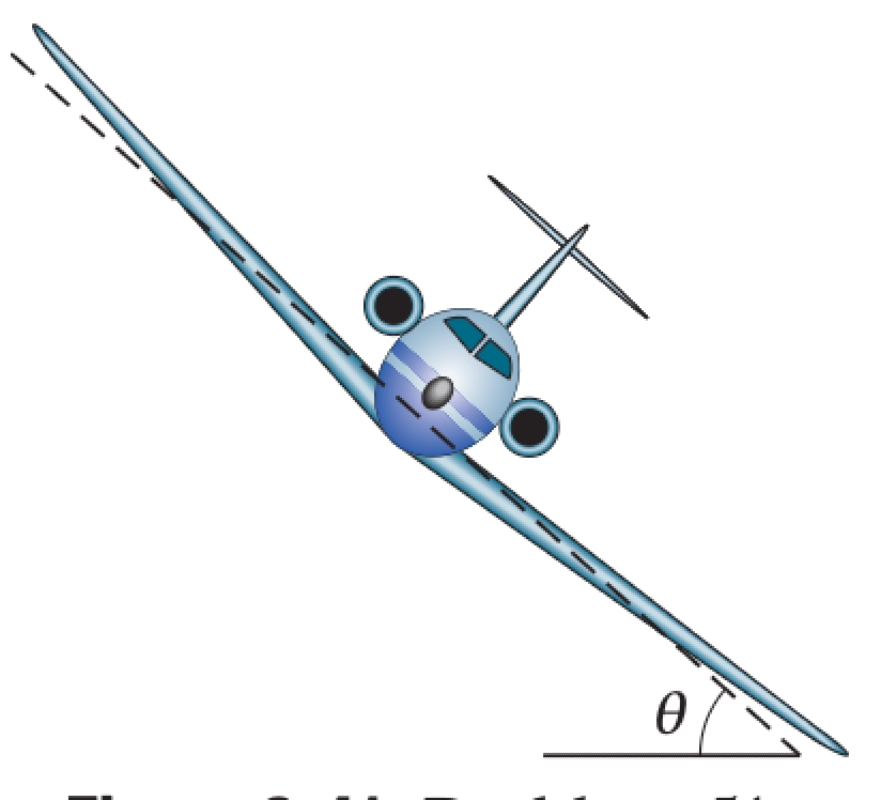
An airplane of mass $m$ is flying in a horizontal circle at a constant speed $v$. Its wings are tilted at an angle $\theta$ to the horizontal. The aerodynamic lift force, $L$, is perpendicular to the wing surface. Let $g$ be the acceleration due to gravity.
P0432-problem-1
The forces acting on the airplane are gravity ($F_g = mg$) acting vertically downwards, and the aerodynamic lift ($L$) acting at an angle $\theta$ with respect to the vertical.
We can resolve the lift force into its vertical and horizontal components:
$$L_y = L \cos\theta$$ $$L_x = L \sin\theta$$For the plane to maintain level flight (no vertical acceleration), the vertical component of the lift must balance the force of gravity:
$$\sum F_y = L_y - mg = 0 \implies L \cos\theta = mg$$The horizontal component of the lift provides the centripetal force required for the airplane to move in a circle of radius $r$ at speed $v$:
$$\sum F_x = L_x = ma_c = \frac{mv^2}{r} \implies L \sin\theta = \frac{mv^2}{r}$$To find the radius $r$, we can divide the horizontal force equation by the vertical force equation to eliminate the lift force $L$ and mass $m$:
$$\frac{L \sin\theta}{L \cos\theta} = \frac{mv^2/r}{mg}$$ $$\tan\theta = \frac{v^2}{rg}$$Solving for the radius $r$:
$$r = \frac{v^2}{g \tan\theta}$$