Source: High school physics (Chinese)
Problem
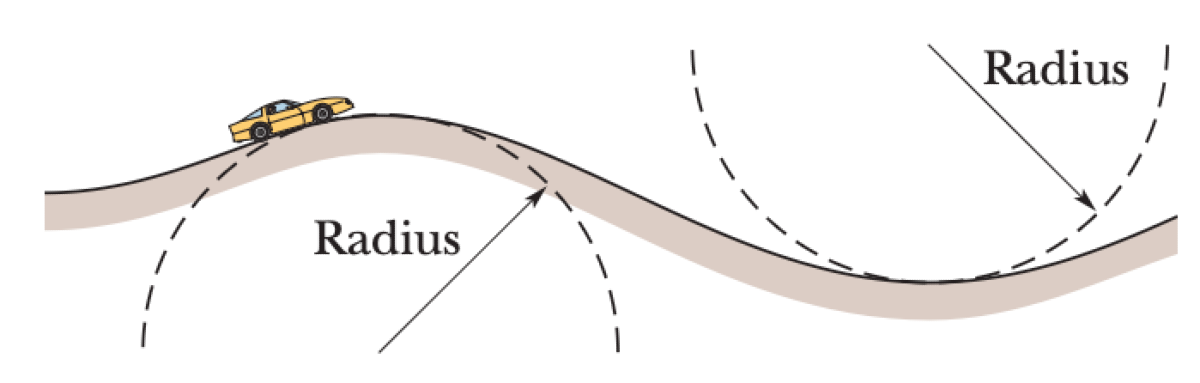
A car is driven at a constant speed $v$ over a circular hill and then into a circular valley, both with the same radius $R$. The driver has a mass $m$. At the top of the hill, the normal force on the driver from the car seat is zero.
P0430-problem-1
Let $g$ be the acceleration due to gravity. The driver undergoes uniform circular motion, so the net force on the driver provides the centripetal force $F_c = mv^2/R$.
At the top of the hill, the gravitational force $mg$ acts downwards and the normal force $N_{top}$ acts upwards. The net force is directed downwards, towards the center of the circle. Applying Newton's second law:
$$mg - N_{top} = \frac{mv^2}{R}$$Given that $N_{top} = 0$, the equation simplifies to:
$$mg = \frac{mv^2}{R} \implies v^2 = gR$$At the bottom of the valley, the gravitational force $mg$ acts downwards and the normal force $N_{bottom}$ acts upwards. The net force is directed upwards, towards the center of the circle. Applying Newton's second law:
$$N_{bottom} - mg = \frac{mv^2}{R}$$Substitute the expression for $v^2$ found from the condition at the top of the hill:
$$N_{bottom} = mg + \frac{m(gR)}{R} = mg + mg$$ $$N_{bottom} = 2mg$$