Source: Principles of Physics
Problem
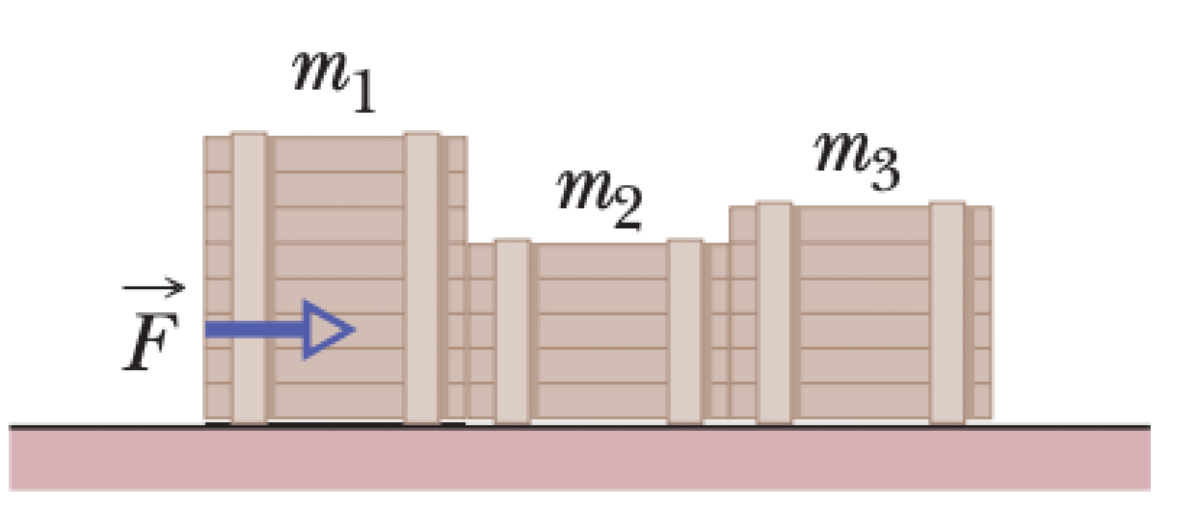
Three crates with masses $m_1$, $m_2$, and $m_3$ are being pushed over a floor by a horizontal force $\vec{F}$ applied to crate 1. The coefficient of kinetic friction between the floor and each crate is $\mu_k$.
- What is the magnitude $F_{32}$ of the force on crate 3 from crate 2?
- If the coefficient of kinetic friction changes, how would the magnitude $F_{32}$ change?

01K63JQRY8K03Q0YY29X62TSPT
[Q1] $F_{32} = \frac{m_3}{m_1+m_2+m_3}F$ [Q2] The magnitude of $F_{32}$ remains unchanged.
First, consider all three crates as a single system with total mass $M = m_1 + m_2 + m_3$. The net horizontal force on the system is the applied force $F$ minus the total kinetic friction force $f_k$.
Applying Newton's second law to the system:
$$F - f_k = Ma$$The total friction force is $f_k = \mu_k N = \mu_k M g$.
$$F - \mu_k Mg = Ma$$Solving for the system's acceleration $a$:
$$a = \frac{F - \mu_k Mg}{M} = \frac{F}{M} - \mu_k g$$Next, apply Newton's second law to crate 3. The net force is the contact force from crate 2, $F_{32}$, minus the friction on crate 3, $f_{k,3}$.
$$F_{32} - f_{k,3} = m_3 a$$The friction force on crate 3 is $f_{k,3} = \mu_k m_3 g$.
$$F_{32} = m_3 a + \mu_k m_3 g$$Substitute the expression for acceleration $a$:
$$F_{32} = m_3 \left( \frac{F}{M} - \mu_k g \right) + \mu_k m_3 g$$ $$F_{32} = \frac{m_3 F}{M} - m_3 \mu_k g + \mu_k m_3 g$$ $$F_{32} = \frac{m_3 F}{M}$$Substituting $M = m_1 + m_2 + m_3$, we find that $F_{32}$ is independent of the coefficient of friction $\mu_k$. Therefore, changing $\mu_k$ does not affect $F_{32}$.