Source: Principles of Physics
Problem
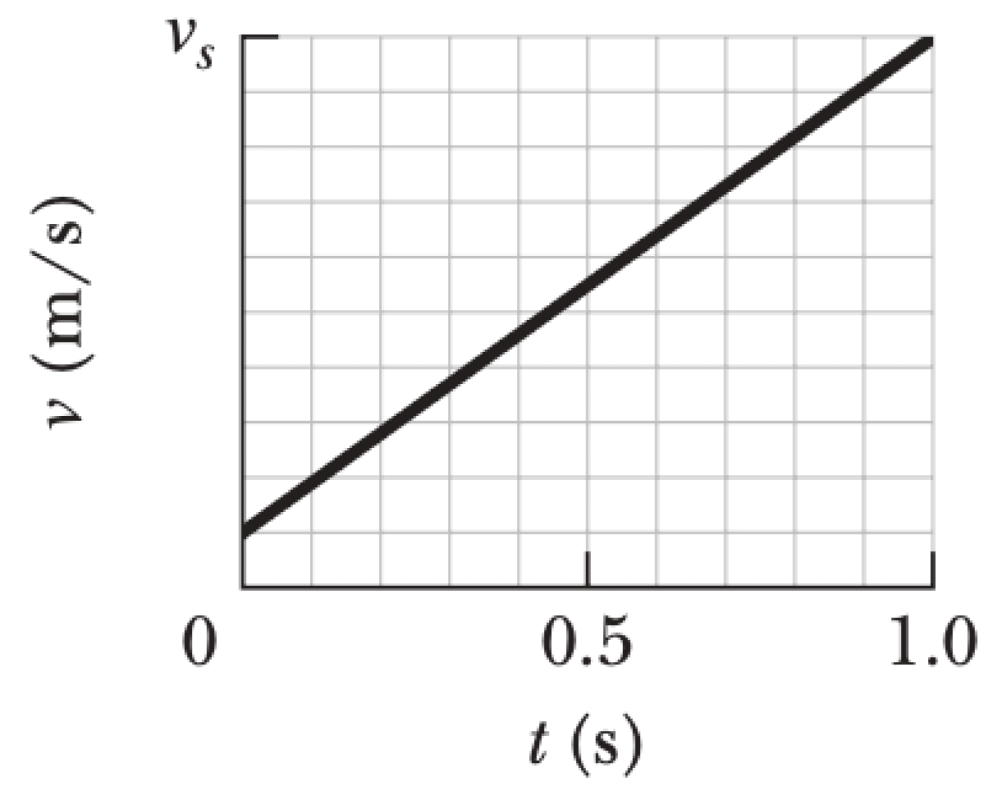
A block of mass $m$ is pushed along a horizontal floor by a constant applied force of magnitude $F$. The block starts from rest and its speed increases linearly with time, reaching a speed $v_s$ at time $t_s$.

01K63JNQPBJ55T1NRM7E3JA2K4
The acceleration $a$ of the block is constant, determined from the velocity-time information:
$$a = \frac{v_s - 0}{t_s - 0} = \frac{v_s}{t_s}$$Apply Newton's second law. In the vertical direction, the normal force $F_N$ balances the gravitational force $mg$:
$$F_N = mg$$The kinetic friction force is $f_k = \mu_k F_N = \mu_k mg$.
In the horizontal direction, the net force is the applied force minus friction:
$$\Sigma F_x = F - f_k = ma$$Substituting the expressions for $f_k$ and $a$:
$$F - \mu_k mg = m \left(\frac{v_s}{t_s}\right)$$Solving for the coefficient of kinetic friction $\mu_k$:
$$\mu_k mg = F - \frac{mv_s}{t_s}$$ $$\mu_k = \frac{1}{mg} \left( F - \frac{mv_s}{t_s} \right) = \frac{F}{mg} - \frac{v_s}{gt_s}$$