Source: Principles of Physics
Problem Sets:
Problem
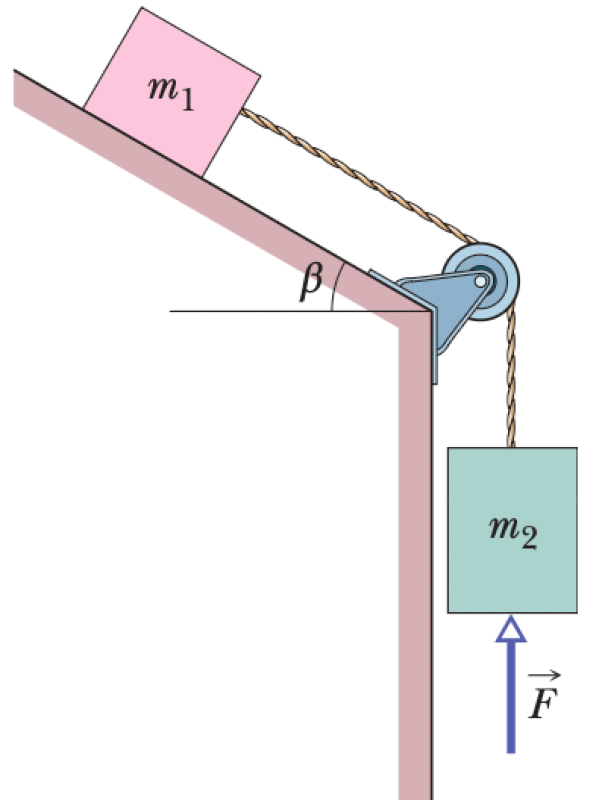
A block of mass $m_1$ on a frictionless inclined surface is connected to a hanging block of mass $m_2$ by a cord running over a massless, frictionless pulley. The incline has an angle $\beta$. An upward force of magnitude $F$ acts on mass $m_2$, which has a downward acceleration of magnitude $a$.
- What is the tension $T$ in the connecting cord?
- What is the angle $\beta$ of the incline?

01K63GC13SMMS99RC34EF7C69H
[Q1] $T = m_2(g - a) - F$ [Q2] $\beta = \arcsin\left(\frac{m_2(g - a) - F - m_1 a}{m_1 g}\right)$
We apply Newton's second law to each mass. Let the downward direction for $m_2$ and the up-the-incline direction for $m_1$ be positive. The acceleration of both blocks has magnitude $a$.
For the hanging mass $m_2$: The net force is the sum of gravity ($m_2 g$), the external force ($F$), and tension ($T$).
$$m_2 g - T - F = m_2 a$$Solving for the tension $T$:
$$T = m_2 g - F - m_2 a = m_2(g - a) - F$$For the mass on the incline $m_1$: The net force along the incline is the sum of tension ($T$) and the component of gravity parallel to the incline ($m_1 g \sin\beta$).
$$T - m_1 g \sin\beta = m_1 a$$Solving for $\sin\beta$:
$$\sin\beta = \frac{T - m_1 a}{m_1 g}$$Substituting the expression for $T$ from the first equation:
$$\sin\beta = \frac{(m_2(g - a) - F) - m_1 a}{m_1 g}$$The angle $\beta$ is the arcsin of this expression. For a physical solution, the argument of the arcsin must be between 0 and 1.