Source: High school physics (Chinese)
Problem Sets:
Problem
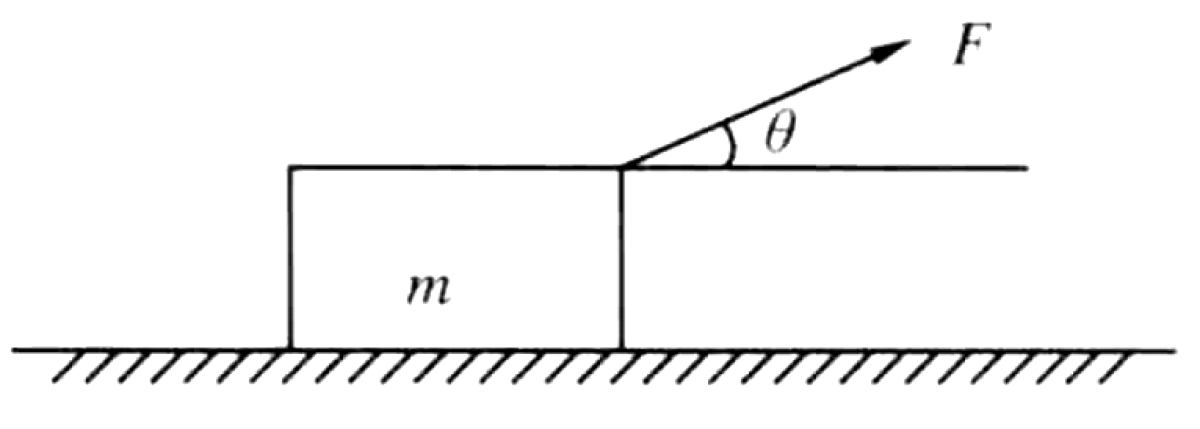
As shown in Figure, an object of mass $m$ is on a horizontal ground. It is pulled by a force of constant magnitude $F$ at an angle $\theta$ with the horizontal, causing it to move to the right. The coefficient of kinetic friction between the object and the ground is $\mu$.
- For what angle $\theta$ does the object have the maximum acceleration?
- What is the value of this maximum acceleration?

01K5Z0EP22Q9AEE63AHSWYSC9M
[Q1] The acceleration is maximized when the angle $\theta$ satisfies:
$$ \tan\theta = \mu $$[Q2] The value of the maximum acceleration is:
$$ a_{max} = \frac{F}{m}\sqrt{1+\mu^2} - \mu g $$We begin by applying Newton's second law to the block in the horizontal (x) and vertical (y) directions.
In the vertical direction, the net force is zero as there is no vertical acceleration:
$$ \sum F_y = N + F\sin\theta - mg = 0 $$From this, we find the normal force $N$:
$$ N = mg - F\sin\theta $$For the block to remain on the ground, $N \ge 0$, which implies $F\sin\theta \le mg$.
In the horizontal direction, the net force causes acceleration $a$:
$$ \sum F_x = F\cos\theta - f_k = ma $$The kinetic friction force is $f_k = \mu N$. Substituting the expression for $N$:
$$ f_k = \mu(mg - F\sin\theta) $$Now, substituting $f_k$ into the horizontal equation of motion:
$$ F\cos\theta - \mu(mg - F\sin\theta) = ma $$Solving for the acceleration $a$ as a function of $\theta$:
$$ a(\theta) = \frac{F\cos\theta - \mu mg + \mu F\sin\theta}{m} $$ $$ a(\theta) = \frac{F}{m}(\cos\theta + \mu \sin\theta) - \mu g $$[Q1] To find the angle $\theta$ that maximizes the acceleration $a(\theta)$, we need to maximize the term $f(\theta) = \cos\theta + \mu \sin\theta$. We can use the harmonic addition theorem to express this in the form $R\cos(\theta - \phi)$.
Let $\cos\theta + \mu\sin\theta = R\cos(\theta - \phi) = R(\cos\theta\cos\phi + \sin\theta\sin\phi)$. By comparing coefficients, we have $R\cos\phi = 1$ and $R\sin\phi = \mu$. Dividing these gives $\tan\phi = \mu$. The amplitude $R$ is found by squaring and adding: $R^2(\cos^2\phi + \sin^2\phi) = 1^2 + \mu^2$, so $R = \sqrt{1+\mu^2}$.
Thus, $f(\theta) = \sqrt{1+\mu^2}\cos(\theta - \phi)$, where $\tan\phi = \mu$. This expression is maximized when $\cos(\theta - \phi) = 1$, which occurs when $\theta - \phi = 0$, or $\theta = \phi$. Therefore, the acceleration is maximum when:
$$ \tan\theta = \mu $$[Q2] The maximum value of the term $f(\theta) = \cos\theta + \mu \sin\theta$ is its amplitude, $R = \sqrt{1+\mu^2}$. Substituting this maximum value into the expression for acceleration gives the maximum acceleration, $a_{max}$:
$$ a_{max} = \frac{F}{m}(\sqrt{1+\mu^2}) - \mu g $$Alternative (Calculus method): To maximize $a(\theta)$, we set its derivative with respect to $\theta$ to zero:
$$ \frac{da}{d\theta} = \frac{d}{d\theta}\left[ \frac{F}{m}(\cos\theta + \mu \sin\theta) - \mu g \right] = \frac{F}{m}(-\sin\theta + \mu \cos\theta) = 0 $$This implies $-\sin\theta + \mu \cos\theta = 0$, which simplifies to $\tan\theta = \mu$. This confirms the result for the optimal angle.