Source: High school physics (Chinese)
Problem Sets:
Problem
As shown in Figure, a motorcycle is turning on a slope with an inclination angle of $\alpha$. The coefficient of static friction between the motorcycle and the slope is $\mu$. The radius of the circular track is $R$.

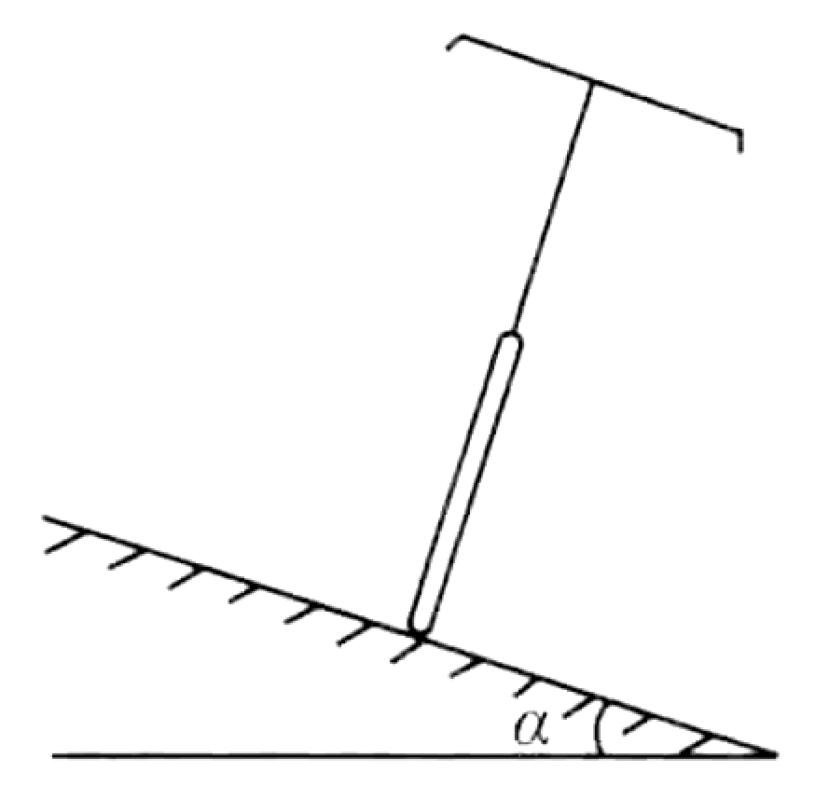
01K5Z053QM2VT9FQ4C5642HESG
The maximum allowable speed of the motorcycle is:
$$v_{max} = \sqrt{gR \left( \frac{\sin\alpha + \mu\cos\alpha}{\cos\alpha - \mu\sin\alpha} \right)} = \sqrt{gR \left( \frac{\tan\alpha + \mu}{1 - \mu\tan\alpha} \right)}$$[SOLUTION] We analyze the forces acting on the motorcycle, modeled as a point mass $m$, in a coordinate system with the horizontal axis pointing towards the center of the circular path and the vertical axis pointing upward. The forces are gravity ($mg$), the normal force ($N$) from the slope, and the static friction force ($f_s$).
For the motorcycle to travel at its maximum allowable speed, $v_{max}$, it must be on the verge of sliding up the slope. Therefore, the force of static friction acts down the slope and has its maximum magnitude, $f_s = \mu N$.
The net force in the horizontal direction provides the required centripetal force for circular motion with radius $R$ and speed $v$:
$$F_{net, horizontal} = m a_c = \frac{m v^2}{R}$$The forces have the following components:
- Normal force $N$: horizontal component $N\sin\alpha$, vertical component $N\cos\alpha$.
- Static friction $f_s$: horizontal component $f_s\cos\alpha$, vertical component $-f_s\sin\alpha$.
- Gravity $mg$: vertical component $-mg$.
Applying Newton's second law in the vertical and horizontal directions:
-
Sum of vertical forces is zero (no vertical acceleration):
$$\sum F_y = N\cos\alpha - f_s\sin\alpha - mg = 0$$Substituting $f_s = \mu N$:
$$N(\cos\alpha - \mu\sin\alpha) = mg \quad (1)$$ -
Sum of horizontal forces equals the centripetal force:
$$\sum F_x = N\sin\alpha + f_s\cos\alpha = \frac{mv^2}{R}$$Substituting $f_s = \mu N$:
$$N(\sin\alpha + \mu\cos\alpha) = \frac{mv^2}{R} \quad (2)$$
To find the speed $v = v_{max}$, we eliminate $N$ and $m$ by dividing equation (2) by equation (1):
$$\frac{N(\sin\alpha + \mu\cos\alpha)}{N(\cos\alpha - \mu\sin\alpha)} = \frac{mv^2/R}{mg}$$ $$\frac{\sin\alpha + \mu\cos\alpha}{\cos\alpha - \mu\sin\alpha} = \frac{v^2}{gR}$$Solving for $v^2$:
$$v^2 = gR \left( \frac{\sin\alpha + \mu\cos\alpha}{\cos\alpha - \mu\sin\alpha} \right)$$This expression can be simplified by dividing the numerator and denominator of the fraction by $\cos\alpha$:
$$v^2 = gR \left( \frac{\frac{\sin\alpha}{\cos\alpha} + \mu}{\frac{\cos\alpha}{\cos\alpha} - \mu\frac{\sin\alpha}{\cos\alpha}} \right) = gR \left( \frac{\tan\alpha + \mu}{1 - \mu\tan\alpha} \right)$$Therefore, the maximum allowable speed is:
$$v_{max} = \sqrt{gR \left( \frac{\tan\alpha + \mu}{1 - \mu\tan\alpha} \right)}$$