Source: Physics Competition - Mechanics
Problem Sets:
Problem
Two particles are launched from the same point on level ground with the same initial speed $v_0$ but at different launch angles, $\alpha_1$ and $\alpha_2$. They move in the same vertical plane and land at the same distance R from the launch point, as shown in Figure (a). Air resistance is negligible.
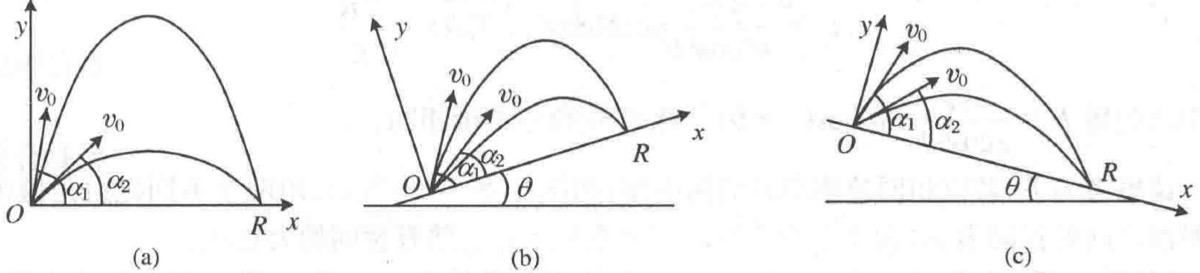
The product of the times of flight $T_1$ and $T_2$ is related to the common range $R$ by the expression:
$$ T_1 T_2 = \frac{2R}{g} $$This demonstrates that the product of the flight times is directly proportional to the range.
[Q1] For a projectile launched from level ground with initial speed $v_0$ at an angle $\alpha$ to the horizontal, the key kinematic equations are for the vertical and horizontal motion.
The time of flight, $T$, is the time taken for the projectile to return to the initial height ($y=0$). The vertical motion is given by $y(t) = (v_0 \sin\alpha) t - \frac{1}{2}gt^2$. Setting $y(T)=0$ for $T>0$ gives the time of flight:
$$ T = \frac{2v_0 \sin\alpha}{g} $$The range, $R$, is the horizontal distance traveled during the time of flight. The horizontal motion is given by $x(t) = (v_0 \cos\alpha) t$.
$$ R = (v_0 \cos\alpha) T = (v_0 \cos\alpha) \left( \frac{2v_0 \sin\alpha}{g} \right) = \frac{v_0^2 \sin(2\alpha)}{g} $$Given that two particles launched with the same speed $v_0$ but different angles $\alpha_1$ and $\alpha_2$ have the same range $R$, we have:
$$ \frac{v_0^2 \sin(2\alpha_1)}{g} = \frac{v_0^2 \sin(2\alpha_2)}{g} \implies \sin(2\alpha_1) = \sin(2\alpha_2) $$Since $\alpha_1 eq \alpha_2$, the angles must be related by $2\alpha_1 + 2\alpha_2 = 180^\circ$, which simplifies to:
$$ \alpha_1 + \alpha_2 = 90^\circ $$This means the angles are complementary. Thus, $\sin\alpha_2 = \sin(90^\circ - \alpha_1) = \cos\alpha_1$.
The times of flight for the two particles are $T_1 = \frac{2v_0 \sin\alpha_1}{g}$ and $T_2 = \frac{2v_0 \sin\alpha_2}{g}$. The product of their times of flight is:
$$ T_1 T_2 = \left( \frac{2v_0 \sin\alpha_1}{g} \right) \left( \frac{2v_0 \sin\alpha_2}{g} \right) = \frac{4v_0^2 \sin\alpha_1 \sin\alpha_2}{g^2} $$Substitute $\sin\alpha_2 = \cos\alpha_1$ into the product expression:
$$ T_1 T_2 = \frac{4v_0^2 \sin\alpha_1 \cos\alpha_1}{g^2} = \frac{2}{g} \left( \frac{2v_0^2 \sin\alpha_1 \cos\alpha_1}{g} \right) $$Recognizing that the term in the parenthesis is the expression for the range $R$ for the first particle, $R = \frac{v_0^2 \sin(2\alpha_1)}{g} = \frac{2v_0^2 \sin\alpha_1 \cos\alpha_1}{g}$, we can substitute $R$ into the equation:
$$ T_1 T_2 = \frac{2R}{g} $$Since $g$ (the acceleration due to gravity) is a constant, the product of the times of flight, $T_1 T_2$, is directly proportional to the range $R$.