Source: Principles of Physics
Problem
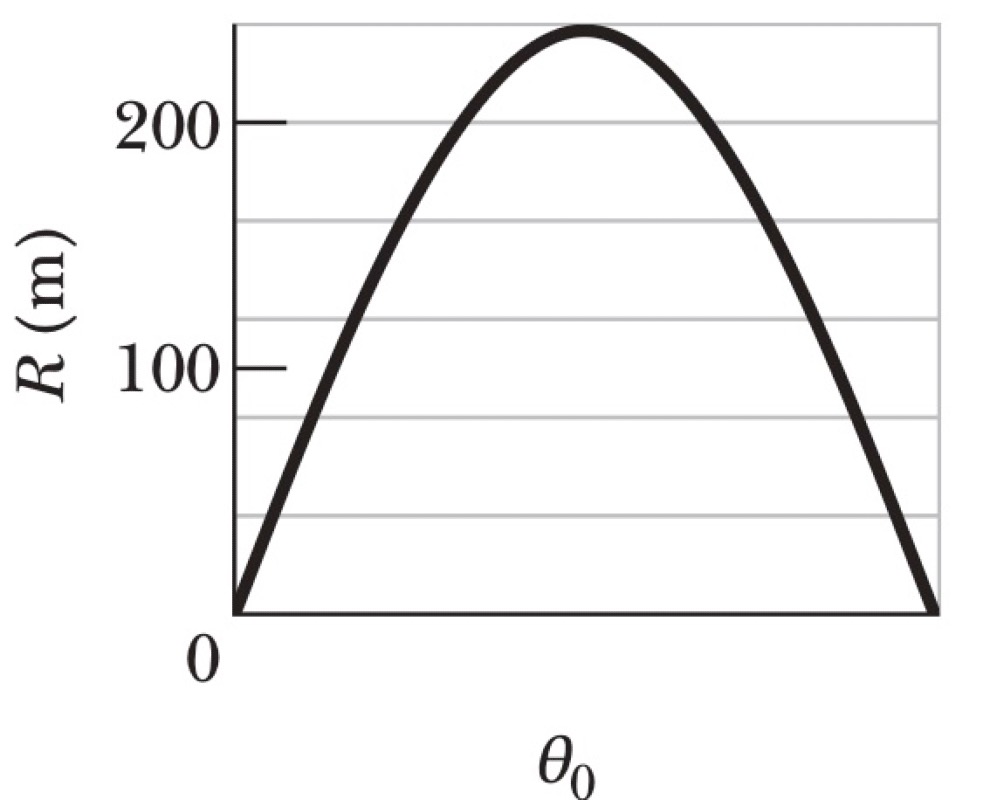
A projectile is launched from level ground with a constant initial speed $v_0$. The launch angle $\theta_0$ can be varied. The maximum possible range is $R_{max}$, and the maximum possible flight time is $t_{max}$.
[Q1] $v_{min} = \sqrt{gR_{max}(1 - \alpha^2)}$
The range of a projectile is $R = (v_0^2 \sin(2\theta_0))/g$. The maximum range $R_{max}$ occurs when $\sin(2\theta_0) = 1$ (at $\theta_0 = 45^\circ$), giving $R_{max} = v_0^2/g$. The initial speed is therefore $v_0 = \sqrt{gR_{max}}$.
The total flight time is $t = (2v_0 \sin\theta_0)/g$. The maximum flight time $t_{max}$ occurs when $\sin\theta_0 = 1$ (at $\theta_0 = 90^\circ$), so $t_{max} = 2v_0/g$.
The problem states that the flight time is a fraction $\alpha$ of the maximum:
$$ t = \alpha t_{max} \implies \frac{2v_0 \sin\theta_0}{g} = \alpha \left(\frac{2v_0}{g}\right) $$This simplifies to $\sin\theta_0 = \alpha$.
The minimum speed during flight, $v_{min}$, occurs at the apex of the trajectory where the vertical velocity is zero. This speed is equal to the constant horizontal component of velocity, $v_x$.
$$ v_{min} = v_x = v_0 \cos\theta_0 $$Using the identity $\cos\theta_0 = \sqrt{1-\sin^2\theta_0}$, we find $\cos\theta_0 = \sqrt{1-\alpha^2}$.
Substituting the expressions for $v_0$ and $\cos\theta_0$ into the equation for $v_{min}$:
$$ v_{min} = (\sqrt{gR_{max}})(\sqrt{1-\alpha^2}) = \sqrt{gR_{max}(1-\alpha^2)} $$