Source: Principles of Physics
Problem
A projectile is launched from the origin with an initial speed $v_0$ at an angle $\theta_0$ above the horizontal. It travels under the influence of gravity $g$. The ground below consists of a flat section followed by a downward slope at an angle $\alpha$ to the horizontal. The angle between the projectile's velocity vector and the slope upon landing is $\phi$.
- In a first case, the projectile lands on the slope at the same vertical level as its launch ($y=0$). Find the angle $\phi$.
- In a second case, the projectile is launched from the edge of the slope and lands on it at a point below the launch level. Find the magnitude of the vertical displacement, $|y|$, for this landing.
- For the landing described in Q2, find the angle $\phi$.
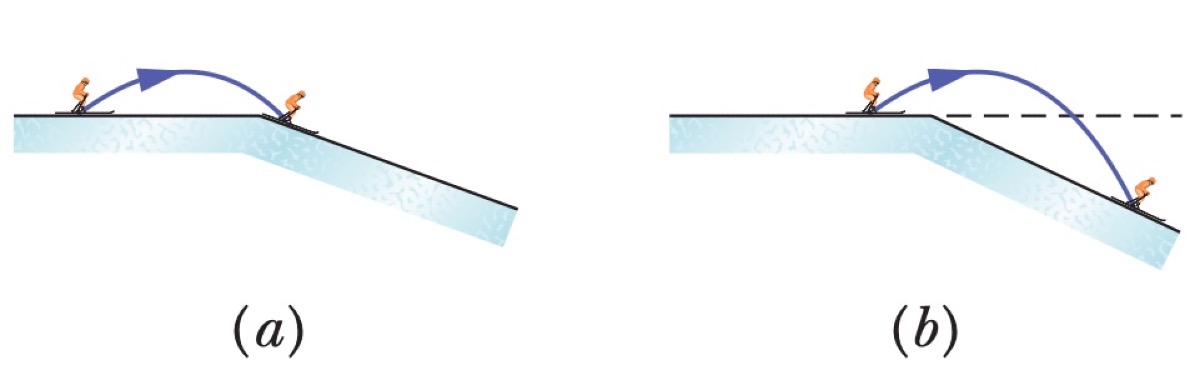
[Q1] $\phi = \theta_0 - \alpha$ [Q2] $|y| = \frac{2v_0^2}{g} \cos\theta_0 \tan\alpha (\sin\theta_0 + \cos\theta_0 \tan\alpha)$ [Q3] $\phi = \arctan(\tan\theta_0 + 2\tan\alpha) - \alpha$
The projectile's position $(x, y)$ and velocity $(v_x, v_y)$ at time $t$ are given by:
$x(t) = (v_0 \cos\theta_0) t$ $y(t) = (v_0 \sin\theta_0) t - \frac{1}{2}gt^2$ $v_x(t) = v_0 \cos\theta_0$ $v_y(t) = v_0 \sin\theta_0 - gt$[Q1] Landing at the same vertical level The landing condition is $y(t) = 0$. Solving for the time of flight $t_a$:
$$t_a = \frac{2v_0 \sin\theta_0}{g}$$At this time, the velocity components are $v_x = v_0 \cos\theta_0$ and $v_y = -v_0 \sin\theta_0$. The landing path is at an angle $\theta_0$ below the horizontal due to symmetry. The slope is at an angle $\alpha$ below the horizontal. The angle between them is their difference.
$$\phi = \theta_0 - \alpha$$[Q2] Landing on the slope below launch level The landing condition is that the projectile's coordinates lie on the line describing the slope, $y = -x \tan\alpha$.
$$(v_0 \sin\theta_0) t - \frac{1}{2}gt^2 = -(v_0 \cos\theta_0) t \tan\alpha$$Solving for the flight time $t_b$ (for $t>0$):
$$t_b = \frac{2v_0}{g}(\sin\theta_0 + \cos\theta_0 \tan\alpha)$$The vertical displacement magnitude is $|y| = x(t_b) \tan\alpha$.
$$|y| = (v_0 \cos\theta_0) t_b \tan\alpha = (v_0 \cos\theta_0) \left[ \frac{2v_0}{g}(\sin\theta_0 + \cos\theta_0 \tan\alpha) \right] \tan\alpha$$ $$|y| = \frac{2v_0^2}{g} \cos\theta_0 \tan\alpha (\sin\theta_0 + \cos\theta_0 \tan\alpha)$$[Q3] Angle $\phi$ for landing on the slope The velocity components at landing time $t_b$ are:
$v_x = v_0 \cos\theta_0$ $v_y = v_0 \sin\theta_0 - g t_b = v_0 \sin\theta_0 - 2v_0(\sin\theta_0 + \cos\theta_0 \tan\alpha) = -v_0(\sin\theta_0 + 2\cos\theta_0 \tan\alpha)$The angle of the landing path below the horizontal, $\theta_{land}'$, is given by $\tan\theta_{land}' = |v_y/v_x|$.
$$\tan\theta_{land}' = \frac{v_0(\sin\theta_0 + 2\cos\theta_0 \tan\alpha)}{v_0 \cos\theta_0} = \tan\theta_0 + 2\tan\alpha$$The angle $\phi$ is the difference between the path angle and the slope angle.
$$\phi = \theta_{land}' - \alpha = \arctan(\tan\theta_0 + 2\tan\alpha) - \alpha$$