Source: Principles of Physics
Problem Sets:
Problem
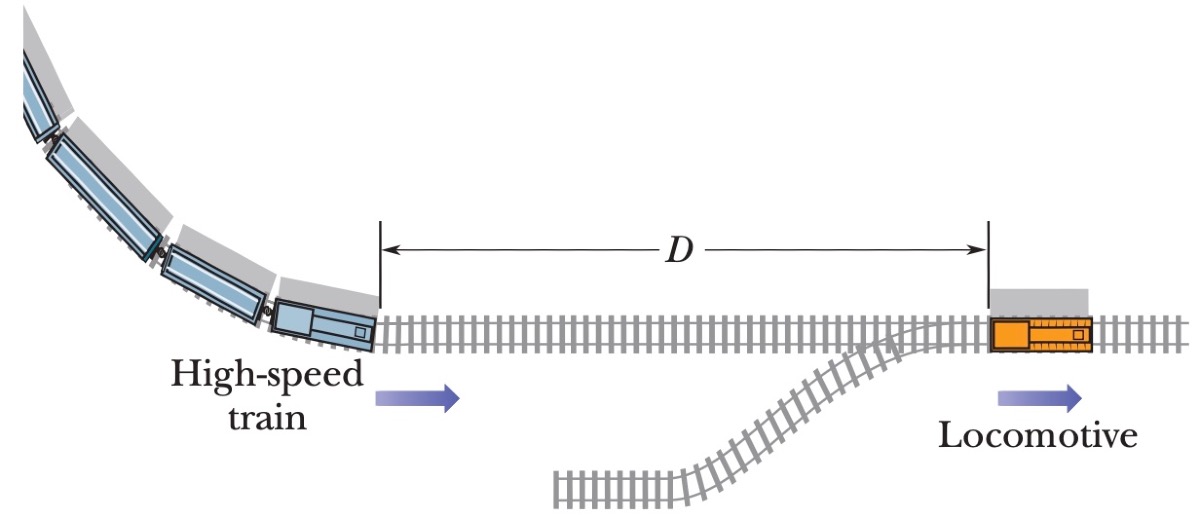
A high-speed train travels at initial velocity $v_H$. It is a distance $D$ behind a locomotive moving in the same direction at a constant velocity $v_L$, where $v_H > v_L$. The train's engineer immediately applies the brakes, causing a constant deceleration of magnitude $a$.
- Find the minimum deceleration magnitude $a$ required to just avoid a collision.
- Sketch the position-time, $x(t)$, curves for both vehicles, showing the cases where a collision is just avoided and not quite avoided.
[Q1] $a = \frac{(v_H - v_L)^2}{2D}$ [Q2] A sketch showing the linear plot of the locomotive's position, $x_L(t) = D + v_L t$, being tangent to the parabolic plot of the high-speed train's position, $x_H(t) = v_H t - \frac{1}{2}at^2$.
We analyze the motion in a reference frame moving with the locomotive.
The initial relative velocity of the high-speed train with respect to the locomotive is $v_{rel,0} = v_H - v_L$. The acceleration of the high-speed train relative to the locomotive is $a_{rel} = -a$, since the locomotive has zero acceleration. The relative distance the train must cover before stopping (relative to the locomotive) is $D$.
To "just avoid" a collision, the final relative velocity must be zero, $v_{rel,f} = 0$, precisely when the train has covered the distance $D$.
Using the time-independent kinematic equation $v_f^2 = v_0^2 + 2a\Delta x$ for the relative motion:
$$v_{rel,f}^2 = v_{rel,0}^2 + 2a_{rel}D$$ $$0^2 = (v_H - v_L)^2 + 2(-a)D$$Solving for the magnitude of the deceleration, $a$:
$$2aD = (v_H - v_L)^2$$ $$a = \frac{(v_H - v_L)^2}{2D}$$For the sketch, the locomotive's position is linear: $x_L(t) = D + v_L t$. The high-speed train's position is parabolic: $x_H(t) = v_H t - \frac{1}{2}at^2$. A collision is "just avoided" when the two curves are tangent, meaning their positions and slopes (velocities) are equal at that instant. A collision occurs if the deceleration is insufficient, causing the parabola to intersect the line.