Source: Collection of Difficult Physics Problems
Problem Sets:
Problem
A small ball is thrown with an initial velocity $v_0$ in a uniform gravitational field. The plane of motion of the ball is the xz plane. The x-axis is horizontal, and the positive z-axis is opposite to the direction of gravitational acceleration $g$. Air resistance is ignored.
- Assume the ball is launched from the origin with a constant initial speed $v_0$. By adjusting the launch angle, all targets within the region $z \le z_0 - kx^2$ can be hit. This inequality does not need to be proven. Find the expressions for the parameters $z_0$ and $k$.
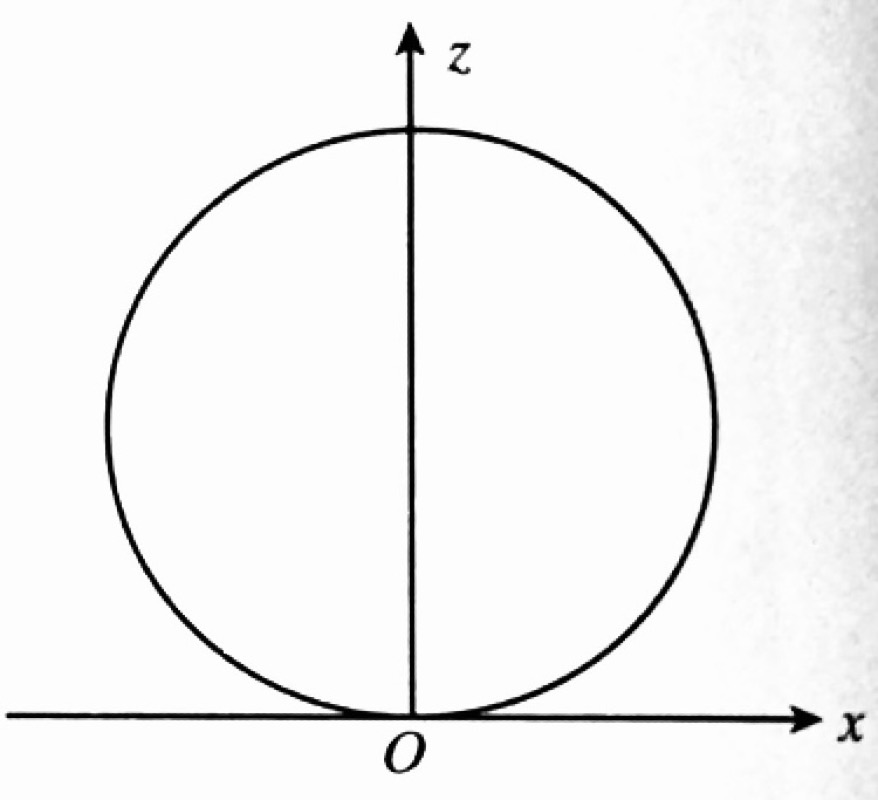
- Now, the launch point of the ball can be chosen anywhere on the horizontal plane $z=0$, and the launch angle can also be adjusted. The objective is to hit the highest point of a spherical building of radius $R$ (Figure 1.1), which rests on the ground at the origin. The ball must not bounce on the building before hitting the target. Qualitatively determine the shape of the ball's optimal trajectory (the one requiring minimum initial speed).
- In order to hit the highest point of the spherical building of radius $R$, find the expression for the minimum initial launch speed $v_{min}$.
[Q1] The parameters of the parabolic safety envelope are:
$z_0 = \frac{v_0^2}{2g}$ $k = \frac{g}{2v_0^2}$[Q2] The optimal trajectory is a parabolic path whose apex is the target point, the highest point of the spherical building. This trajectory is symmetric about the z-axis and is tangent to the sphere at its apex with the same curvature.
[Q3] The minimum initial launch speed required is:
$$v_{min} = \sqrt{5gR}$$[Q1] Parabolic Safety Envelope The equations of motion for a projectile launched from the origin with speed $v_0$ at an angle $\theta$ to the horizontal are:
$$x(t) = (v_0 \cos\theta) t$$ $$z(t) = (v_0 \sin\theta) t - \frac{1}{2}gt^2$$Eliminating time $t$ yields the trajectory equation:
$$z = x \tan\theta - \frac{g x^2}{2v_0^2 \cos^2\theta}$$Using the identity $\sec^2\theta = 1/\cos^2\theta = 1 + \tan^2\theta$, we can express this as a quadratic equation for $T = \tan\theta$:
$$z = xT - \frac{gx^2}{2v_0^2}(1+T^2)$$ $$\left(\frac{gx^2}{2v_0^2}\right)T^2 - xT + \left(z + \frac{gx^2}{2v_0^2}\right) = 0$$For a point $(x, z)$ to be reachable, this quadratic equation must have real solutions for $T$. The condition is that the discriminant $\Delta$ must be non-negative ($\Delta \ge 0$).
$$\Delta = (-x)^2 - 4\left(\frac{gx^2}{2v_0^2}\right)\left(z + \frac{gx^2}{2v_0^2}\right) \ge 0$$For $x eq 0$, we can divide by $x^2$:
$$1 - \frac{2g}{v_0^2}\left(z + \frac{gx^2}{2v_0^2}\right) \ge 0$$ $$1 - \frac{2gz}{v_0^2} - \frac{g^2x^2}{v_0^4} \ge 0$$Rearranging the inequality for $z$:
$$\frac{2gz}{v_0^2} \le 1 - \frac{g^2x^2}{v_0^4}$$ $$z \le \frac{v_0^2}{2g} - \frac{g}{2v_0^2}x^2$$This inequality defines the reachable region. Comparing this with the given form $z \le z_0 - kx^2$, we identify the parameters:
$$z_0 = \frac{v_0^2}{2g}$$ $$k = \frac{g}{2v_0^2}$$[Q2] Optimal Trajectory Shape The target is the highest point of the sphere, at coordinates $(0, 2R)$. The launch point is on the x-axis, at some position $(-d, 0)$ (by symmetry, we can consider $x < 0$). To minimize the initial speed $v_0$ required to reach a certain height, the projectile should not have any "wasted" vertical motion. This means the projectile should reach its maximum height exactly at the target. Therefore, the apex of the optimal trajectory is the target point $(0, 2R)$. A trajectory with its apex on the z-axis must be symmetric with respect to the z-axis. The condition that the ball must not bounce on the building means the trajectory must lie entirely outside the sphere for $x \in (-d, 0)$. Since the trajectory and the sphere are tangent at the apex $(0, 2R)$ (both have a horizontal tangent), the trajectory must have a curvature less than or equal to the sphere's curvature at this point to stay outside. To minimize launch speed, which increases with launch distance $d$ (as shown in Q3), we must choose the smallest possible $d$. This corresponds to the limiting case where the trajectory just grazes the sphere, meaning its curvature at the apex is equal to the sphere's curvature. Thus, the optimal trajectory is a parabola with its vertex at $(0, 2R)$, symmetric about the z-axis, and having the same curvature as the sphere at its apex.
[Q3] Minimum Initial Launch Speed Following the reasoning from Q2, the optimal trajectory has its apex at the target $(0, 2R)$. Let the launch point be $(-d, 0)$ and the initial velocity be $v_{min}$. The velocity at the apex is purely horizontal, let's call it $v_x$. By conservation of energy between the launch point and the apex:
$$\frac{1}{2}mv_{min}^2 = \frac{1}{2}mv_x^2 + mg(2R)$$ $$v_{min}^2 = v_x^2 + 4gR$$The time $t$ for the ball to travel from the launch point to the apex can be found from the vertical motion: $v_{z, apex} = v_{z, initial} - gt = 0$, and $2R = v_{z, initial}t - \frac{1}{2}gt^2$. This gives $v_{z, initial}=\sqrt{4gR}$. The horizontal motion is uniform: $d = v_x t$. The time to reach the apex is $t = v_{z, initial}/g = \sqrt{4R/g}$. So, $d = v_x \sqrt{4R/g}$, which gives $v_x^2 = \frac{d^2g}{4R}$. Substituting this into the energy equation:
$$v_{min}^2 = \frac{d^2g}{4R} + 4gR$$The trajectory is a parabola symmetric about the z-axis, passing through $(-d, 0)$ and with its vertex at $(0, 2R)$. Its equation is $z(x) = 2R - \frac{2R}{d^2}x^2$. For this trajectory to not intersect the sphere $x^2+(z-R)^2 = R^2$, its curvature at the apex $(0, 2R)$ must be less than or equal to the sphere's curvature. The curvature of the trajectory at its apex ($x=0$) is $\kappa_p = |z''(0)| = \frac{4R}{d^2}$. The curvature of the sphere at its apex is $\kappa_s = \frac{1}{R}$. The non-collision constraint is $\kappa_p \le \kappa_s$:
$$\frac{4R}{d^2} \le \frac{1}{R} \implies d^2 \ge 4R^2 \implies d \ge 2R$$The function $v_{min}^2(d) = \frac{g}{4R}d^2 + 4gR$ is an increasing function of $d$ for $d>0$. To minimize $v_{min}$, we must choose the minimum allowed value for $d$, which is $d = 2R$. Substituting $d=2R$ into the expression for $v_{min}^2$:
$$v_{min}^2 = \frac{(2R)^2g}{4R} + 4gR = \frac{4R^2g}{4R} + 4gR = gR + 4gR = 5gR$$ $$v_{min} = \sqrt{5gR}$$