Source: Collection of Difficult Physics Problems
Problem Sets:
Problem
As shown in the figure, two balls, Ball 1 and Ball 2, are launched horizontally from the same point at a height $H$ above the ground. The origin O is directly below the launch point. The initial horizontal velocities are $v_1$ and $v_2$ respectively, with $v_1 > v_2$. Ball 1's trajectory just clears the top of a vertical rod of height $h$ located at a horizontal position $x_P$. Ball 1 then lands on the ground at a horizontal distance $R$ from the origin. Ball 2 is launched, lands on the ground at $x=R/3$, undergoes a perfect elastic collision, and its rebound trajectory also just clears the top of the same rod. Ball 2's second landing point is also at $x=R$.
- Find the ratio $v_1/v_2$.
- Find the position of the rod, $x_P$.
- Find the height of the rod, $h$.
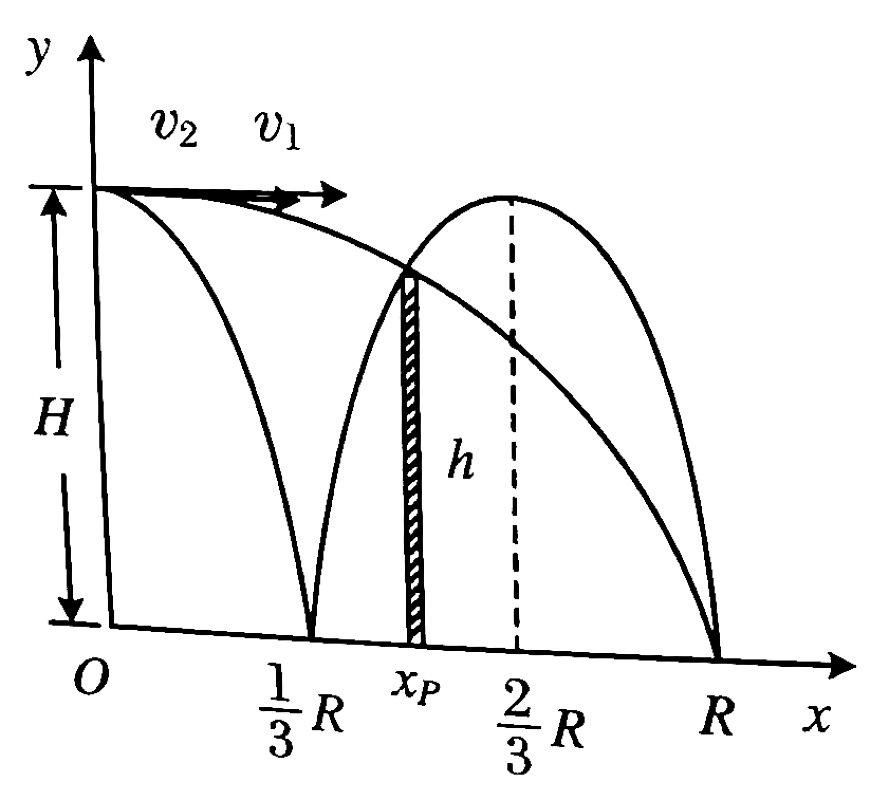
[Q1] The ratio of the initial velocities is:
$$ \frac{v_1}{v_2} = 3 $$[Q2] The position of the rod is:
$$ x_P = \frac{R}{2} $$[Q3] The height of the rod is:
$$ h = \frac{3}{4}H $$Key Concepts and Equations The motion of a projectile launched horizontally from height $H$ with velocity $v$ is described by:
- Horizontal position: $x(t) = vt$
- Vertical position: $y(t) = H - \frac{1}{2}gt^2$ Eliminating time $t=x/v$ gives the trajectory equation:
A perfect elastic collision with the horizontal ground reverses the vertical component of velocity while keeping the horizontal component constant.
[Q1] Find the ratio $v_1/v_2$. Both balls are launched from the same height $H$. The time of flight $T$ to the ground is determined solely by the vertical motion: $H = \frac{1}{2}gT^2$, so $T = \sqrt{2H/g}$ for both balls' initial descent.
For Ball 1, it lands at a horizontal distance $R$.
$$R = v_1 T = v_1 \sqrt{\frac{2H}{g}} \quad (1)$$For Ball 2, it first lands at a horizontal distance $R/3$.
$$\frac{R}{3} = v_2 T = v_2 \sqrt{\frac{2H}{g}} \quad (2)$$To find the ratio $v_1/v_2$, we divide equation (1) by equation (2):
$$\frac{R}{R/3} = \frac{v_1 \sqrt{2H/g}}{v_2 \sqrt{2H/g}}$$ $$3 = \frac{v_1}{v_2}$$[Q2] Find the position of the rod, $x_P$. First, we establish the trajectory equations for both paths that clear the rod.
Trajectory of Ball 1: From equation (1), we can express the term $\frac{g}{2v_1^2}$ as $\frac{H}{R^2}$. Substituting this into the general trajectory equation gives:
$$y_1(x) = H - H\frac{x^2}{R^2} = H\left(1 - \frac{x^2}{R^2}\right) \quad (3)$$Trajectory of Ball 2 (rebound): Ball 2's rebound starts at $(R/3, 0)$ and ends at $(R, 0)$. Due to the perfect elastic collision, the rebound trajectory is a symmetric parabola. Its vertex (maximum height) occurs at the midpoint of its horizontal range.
- Vertex x-coordinate: $x_v = \frac{R/3 + R}{2} = \frac{2R}{3}$
- The peak height of the rebound is equal to the initial drop height $H$ (by conservation of energy, or time-reversal symmetry). So, the vertex is at $(2R/3, H)$. The equation for a parabola with vertex $(x_v, y_v)$ is $y = a(x-x_v)^2 + y_v$.
Since the parabola passes through $(R, 0)$:
$0 = a\left(R - \frac{2R}{3}\right)^2 + H \implies 0 = a\left(\frac{R}{3}\right)^2 + H \implies a = -\frac{9H}{R^2}$So, the rebound trajectory is:
$$y_{reb}(x) = H - \frac{9H}{R^2}\left(x - \frac{2R}{3}\right)^2 \quad (4)$$Both trajectories pass through the point $(x_P, h)$. Therefore, $h = y_1(x_P) = y_{reb}(x_P)$.
$$H\left(1 - \frac{x_P^2}{R^2}\right) = H - \frac{9H}{R^2}\left(x_P - \frac{2R}{3}\right)^2$$Canceling $H$ and simplifying:
$$-\frac{x_P^2}{R^2} = -\frac{9}{R^2}\left(x_P^2 - \frac{4R}{3}x_P + \frac{4R^2}{9}\right)$$ $$x_P^2 = 9\left(x_P^2 - \frac{4R}{3}x_P + \frac{4R^2}{9}\right)$$ $$x_P^2 = 9x_P^2 - 12Rx_P + 4R^2$$ $$8x_P^2 - 12Rx_P + 4R^2 = 0$$Dividing by 4:
$$2x_P^2 - 3Rx_P + R^2 = 0$$Factoring the quadratic equation:
$$(2x_P - R)(x_P - R) = 0$$The solutions are $x_P = R$ or $x_P = R/2$. From the figure, the rod is located before the final landing point, so $x_P eq R$.
$$x_P = \frac{R}{2}$$[Q3] Find the height of the rod, $h$. Substitute the value of $x_P = R/2$ into the simpler trajectory equation for Ball 1 (equation 3):
$$h = y_1(x_P) = H\left(1 - \frac{x_P^2}{R^2}\right)$$ $$h = H\left(1 - \frac{(R/2)^2}{R^2}\right) = H\left(1 - \frac{R^2/4}{R^2}\right)$$ $$h = H\left(1 - \frac{1}{4}\right) = \frac{3}{4}H$$