Source: High School Physics Olympiad
Problem Sets:
Problem
A horizontal frictionless circular tabletop has radius $R = 1.00$ m and center $O$. A vertical pillar is fixed on the tabletop near its center; the pillar's cross-section at the table surface is a smooth convex closed curve $C$. One end of an inextensible, flexible, thin light string is fixed to a point on the curve $C$, and the other end is tied to a small block of mass $m = 7.5 \times 10^{-2}$ kg. The block is placed on the tabletop with the string taut and is given an initial velocity $v_0 = 4.0$ m/s perpendicular to the string. As the block moves, the string winds around the pillar. The string breaks when its tension reaches $T_0 = 2.0$ N; before breaking, the block always moves on the tabletop and never touches the pillar. Take g = 10 m/s$^2$.
- What is the length of the straight (taut) part of the string just before it breaks?
- Suppose that just as the string is about to break, the line from the table center $O$ to the point where the straight part of the string touches the curve $C$ is exactly perpendicular to the straight part. Given the tabletop height $H = 0.80$ m, what is the horizontal distance from the block's landing point to the center $O$?
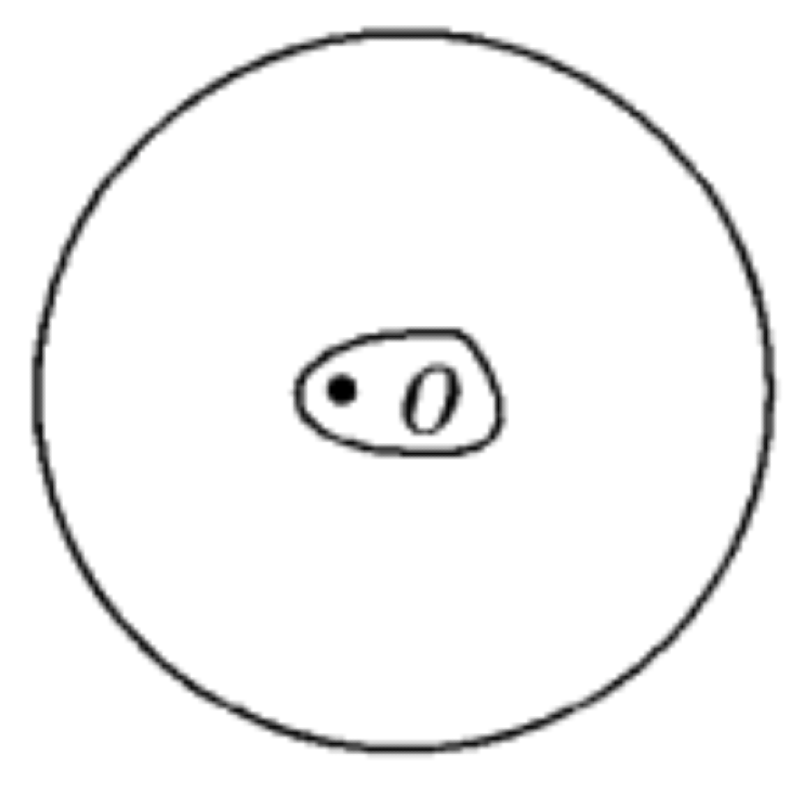
Q1: The string tension is always perpendicular to the block's velocity (the block moves on an instantaneous circle centered at the tangent point on the pillar), so the tension does no work and the speed remains $v_0 = 4.0$ m/s throughout.
Just before breaking, the straight part of length $\ell$ is the radius of the instantaneous circular motion:
$$T_0 = \frac{mv_0^2}{\ell} \quad\Rightarrow\quad \ell = \frac{mv_0^2}{T_0} = \frac{(7.5 \times 10^{-2})(4.0)^2}{2.0} = 0.60 \text{ m}$$Q2: Let $Q$ be the tangent point and $P$ the block's position at the moment of breaking. The velocity is perpendicular to $QP$, hence parallel to $OQ$. After the break the block slides in a straight line along this direction. Since $OQ$ lies along the path direction and $QP \perp OQ$, the perpendicular distance from $O$ to the block's straight path is exactly $\ell = 0.60$ m — the path is a chord of the table edge.
The block leaves the table at the end of this chord, at along-chord distance $\sqrt{R^2 - \ell^2} = \sqrt{1.00^2 - 0.60^2} = 0.80$ m from the foot of the perpendicular, still moving at $v_0 = 4.0$ m/s.
Falling from height $H$: $t = \sqrt{\dfrac{2H}{g}} = \sqrt{\dfrac{2(0.80)}{10}} = 0.40$ s, covering a horizontal distance $v_0 t = 1.6$ m along the same direction.
The landing point therefore has along-chord coordinate $0.80 + 1.6 = 2.4$ m and perpendicular coordinate $0.60$ m relative to $O$:
$$d = \sqrt{2.4^2 + 0.6^2} = \sqrt{6.12} \approx 2.5 \text{ m}$$