Source: High School Physics Olympiad
Problem Sets:
Problem
Two horizontal tracks lie in the same vertical plane, separated by a height $h$. Objects $A$ and $B$, one on each track, are connected by an inextensible light rope passing over a fixed pulley $O$ located at the level of the lower track. Object $A$ moves along the lower track with uniform speed $v$ (away from the pulley), while $B$ slides along the upper track toward the point above $O$. At the instant when the rope segment between the tracks makes a 30° angle with the tracks, a small water droplet $P$ sitting at the midpoint of segment $OB$ (at rest relative to the rope) detaches from the rope. The rope length $BO$ is much larger than the pulley diameter. (15th National High School Physics Competition, second round)
- Find the magnitude and direction of the velocity of droplet $P$ at the moment it leaves the rope.
- Find the time needed for $P$ to fall to the lower track after leaving the rope.
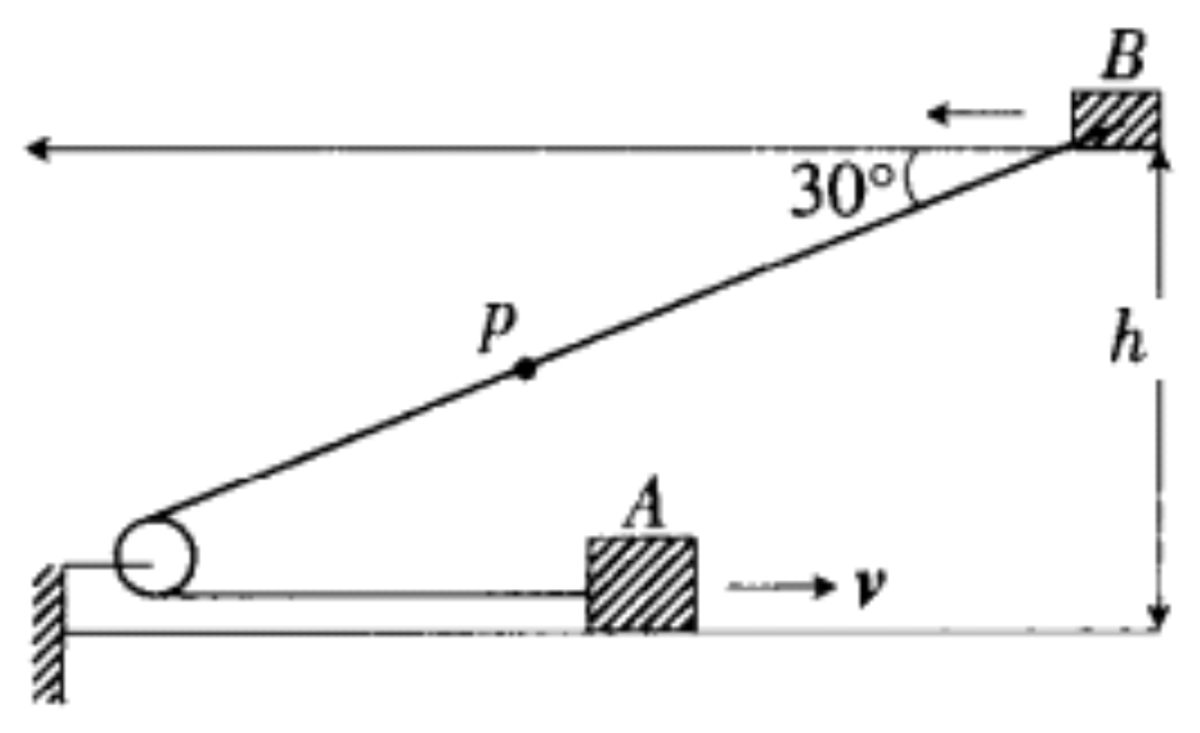
Q1: Since $A$ moves at speed $v$, rope feeds over the pulley at rate $v$ and the segment $OB$ shortens at rate $v$. The component of $B$'s velocity along the rope must equal this rate:
$$v_B\cos 30° = v \quad\Rightarrow\quad v_B = \frac{2v}{\sqrt{3}}$$Treat $O$ as a fixed point (since $BO$ is much larger than the pulley diameter). Decompose the motion of rope material along and perpendicular to the straight segment $OB$:
Along the rope: inextensibility makes this component the same for every material point, equal to $v$ (directed toward $O$).
Perpendicular to the rope: the segment rotates about $O$ with angular velocity $\omega$ found from $B$'s perpendicular component, $v_B\sin 30° = \omega\,s$ where $s = OB$, so $\omega = \dfrac{v}{\sqrt{3}\,s}$. The midpoint $P$ (distance $s/2$ from $O$) has perpendicular speed $\omega\dfrac{s}{2} = \dfrac{v}{2\sqrt{3}}$.
With the rope at 30° to the horizontal, converting to horizontal and vertical components:
$$v_{Px} = v\cos 30° + \frac{v}{2\sqrt{3}}\sin 30° = \frac{7\sqrt{3}}{12}v \text{ (toward the pulley side)}, \qquad v_{Py} = v\sin 30° - \frac{v}{2\sqrt{3}}\cos 30° = \frac{v}{4} \text{ (downward)}$$ $$|v_P| = \sqrt{\left(\frac{7\sqrt{3}}{12}\right)^2 + \left(\frac{1}{4}\right)^2}\;v = \frac{\sqrt{39}}{6}v \approx 1.04v$$The velocity points in the horizontal direction of $B$'s motion and downward, at angle $\delta$ below the horizontal with $\tan\delta = \dfrac{\sqrt{3}}{7}$, i.e. $\delta \approx 14°$.
Q2: Since the rope makes 30° with the tracks, $s\sin 30° = h$ gives $s = 2h$, and the midpoint $P$ is at height $\dfrac{h}{2}$ above the lower track. After detaching, $P$ is a projectile with initial downward velocity component $\dfrac{v}{4}$:
$$\frac{h}{2} = \frac{v}{4}t + \frac{1}{2}gt^2$$Solving the quadratic $gt^2 + \dfrac{v}{2}t - h = 0$ for the positive root:
$$t = \frac{\sqrt{v^2 + 16gh} - v}{4g}$$