Source: High School Physics Olympiad
Problem Sets:
Problem
A ship sails parallel to a straight coastline at distance $D$ from the shore with speed $V$. A speedboat with speed $v$ ($v < V$) starts from a port on the coastline to intercept the ship.
- Prove that the speedboat must depart before the ship passes a certain point on the coastline located a distance $x = \dfrac{D\sqrt{V^2 - v^2}}{v}$ from the port, on the side from which the ship approaches.
- If the speedboat departs at the latest possible moment, where and when does it intercept the ship?
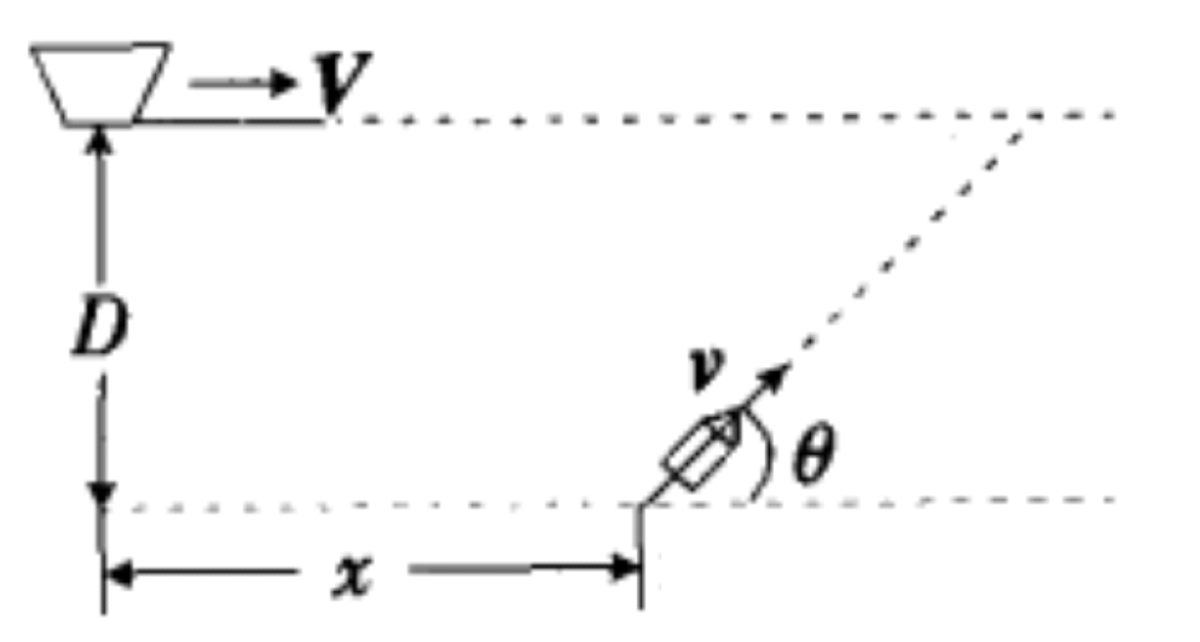
Q1: departure required while the ship is at least $x = \dfrac{D\sqrt{V^2-v^2}}{v}$ before the port; Q2: interception at $\dfrac{Dv}{\sqrt{V^2-v^2}}$ past the port ($D$ offshore) at time $t = \dfrac{VD}{v\sqrt{V^2-v^2}}$ after departure
Place the port at the origin with the coastline along the $x$-axis; the ship moves in the $+x$ direction at $y = D$. Let the boat depart at $t = 0$ when the ship's projection on the coast is at distance $x_0$ before the port, i.e. the ship is at $(-x_0, D)$.
Q1: Interception at time $t$ requires the boat (speed $v$ from the origin) to reach the ship's position:
$$(Vt - x_0)^2 + D^2 = v^2t^2$$ $$(V^2 - v^2)t^2 - 2Vx_0 t + (x_0^2 + D^2) = 0$$A real positive solution requires the discriminant to be non-negative:
$$4V^2x_0^2 - 4(V^2 - v^2)(x_0^2 + D^2) \ge 0 \quad\Rightarrow\quad v^2x_0^2 \ge (V^2 - v^2)D^2$$ $$x_0 \ge \frac{D\sqrt{V^2 - v^2}}{v} = x$$So the boat must leave before the ship passes the coastline point a distance $x$ before the port. $\blacksquare$
Q2: At the latest departure, $x_0 = x$ and the discriminant vanishes, giving the single root:
$$t = \frac{Vx_0}{V^2 - v^2} = \frac{VD}{v\sqrt{V^2 - v^2}}$$The interception point has $x$-coordinate $Vt - x_0 = \dfrac{Dv}{\sqrt{V^2 - v^2}}$, i.e. the boat catches the ship a distance $\dfrac{Dv}{\sqrt{V^2 - v^2}}$ past the port (in the ship's direction of motion), at distance $D$ offshore. The boat's heading then makes angle $\theta$ with the coastline where $\cos\theta = \dfrac{v}{V}$.