Source: High School Physics Olympiad
Problem Sets:
Problem
A small ball starts from rest at point $O$ located above an inclined plane of inclination angle $\theta$ and slides down a smooth straight chute $OA$ that ends on the incline.
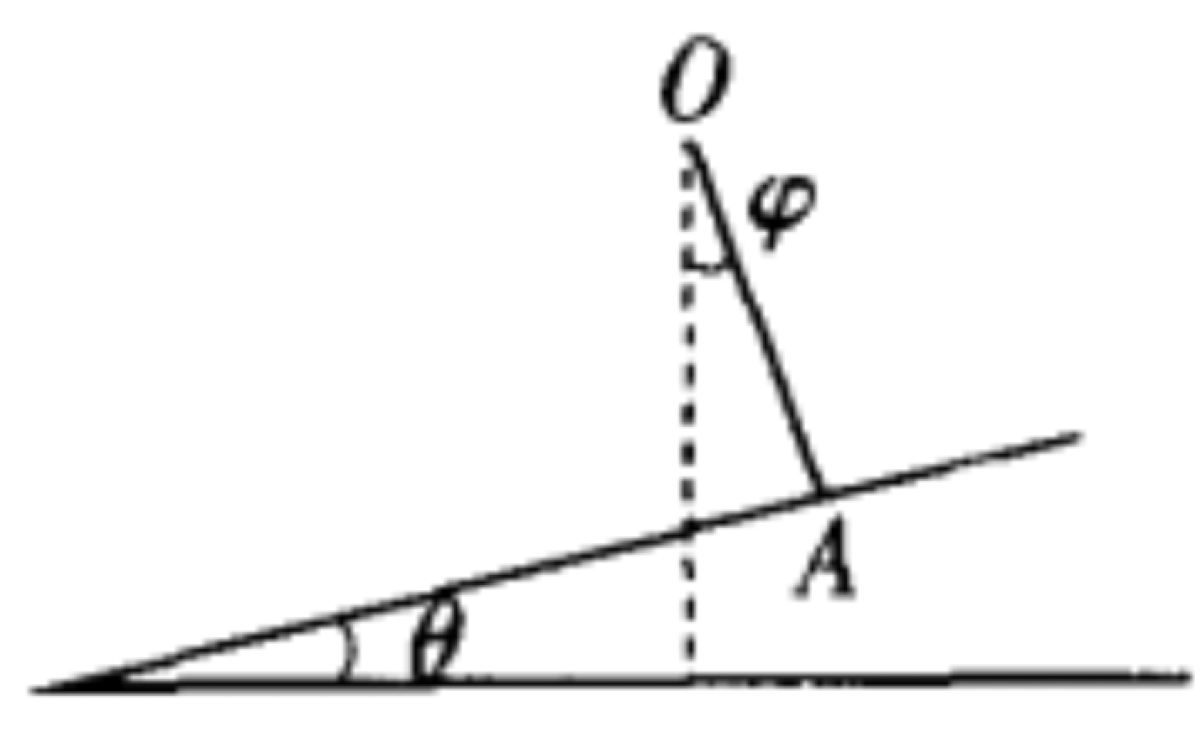
Let the vertical line through $O$ meet the incline at $P$, with $OP = h$. The chute makes angle $\varphi$ with the vertical, so the acceleration along it is $g\cos\varphi$.
In triangle $OPA$, the angle at $P$ between the vertical and the incline surface is $90° - \theta$, and the angle at $A$ is $90° + \theta - \varphi$. By the sine rule:
$$L = OA = \frac{h\sin(90° - \theta)}{\sin(90° + \theta - \varphi)} = \frac{h\cos\theta}{\cos(\varphi - \theta)}$$From $L = \frac{1}{2}(g\cos\varphi)t^2$:
$$t^2 = \frac{2h\cos\theta}{g\cos\varphi\cos(\varphi - \theta)}$$Using $\cos\varphi\cos(\varphi - \theta) = \frac{1}{2}[\cos(2\varphi - \theta) + \cos\theta]$, the time is minimum when $\cos(2\varphi - \theta) = 1$, i.e. $2\varphi = \theta$.