Source: High school physics (Chinese)
Problem Sets:
Problem
- Determine the direction of the induced current in circuit $ABCD$.
- Determine the direction of the induced current in circuit $ABEF$.
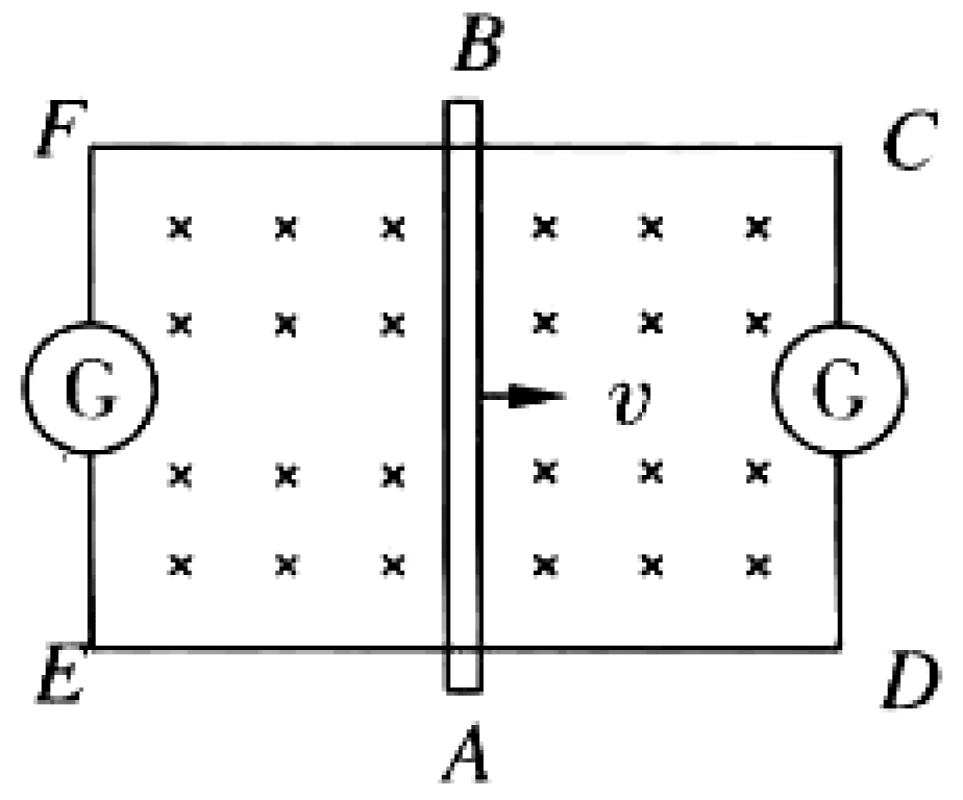
Circuit $ABCD$: $A \to B \to C \to D \to A$ (clockwise). Circuit $ABEF$: $A \to B \to F \to E \to A$ (counterclockwise).
In the moving rod the magnetic force on a positive charge is $q\vec{v}\times\vec{B}$. With $\vec{v}$ to the right and $\vec{B}$ into the page, this force points from $A$ to $B$ (upward), so $B$ is the high-potential end and the rod acts as the source, driving current from $A$ to $B$ inside it.
Circuit $ABCD$ (right): as the rod moves right this loop shrinks, so the into-page flux through it decreases. By Lenz's law the induced current is clockwise to maintain the flux: $A \to B \to C \to D \to A$.
Circuit $ABEF$ (left): as the rod moves right this loop grows, so the into-page flux increases. By Lenz's law the induced current is counterclockwise to oppose it: $A \to B \to F \to E \to A$.
Both results agree that the current in the shared rod flows from $A$ to $B$.