Source: High school physics (Chinese)
Problem Sets:
Problem
At a certain instant, a simple harmonic wave of amplitude $A = 0.2$ m, period $T$, and wavelength $\lambda$ travels in the $+y$ direction. At this instant the transverse displacements are: a crest $x = +0.2$ m at point $O$ ($y = 0$), zero at $a$ ($y = \lambda/4$), a trough $x = -0.2$ m at $b$ ($y = \lambda/2$), zero at $c$ ($y = 3\lambda/4$), and a crest at $d$ ($y = \lambda$). Take $t = 0$ at this instant.
- Sketch the waveform at $t = 3T/8$ and at $t = 7T/6$.
- If instead the wave travels in the $-y$ direction, describe how the waveform would appear.
- Write the displacement of each of the points $O$, $a$, $b$, $c$, $d$ as a function of time, using sine functions.
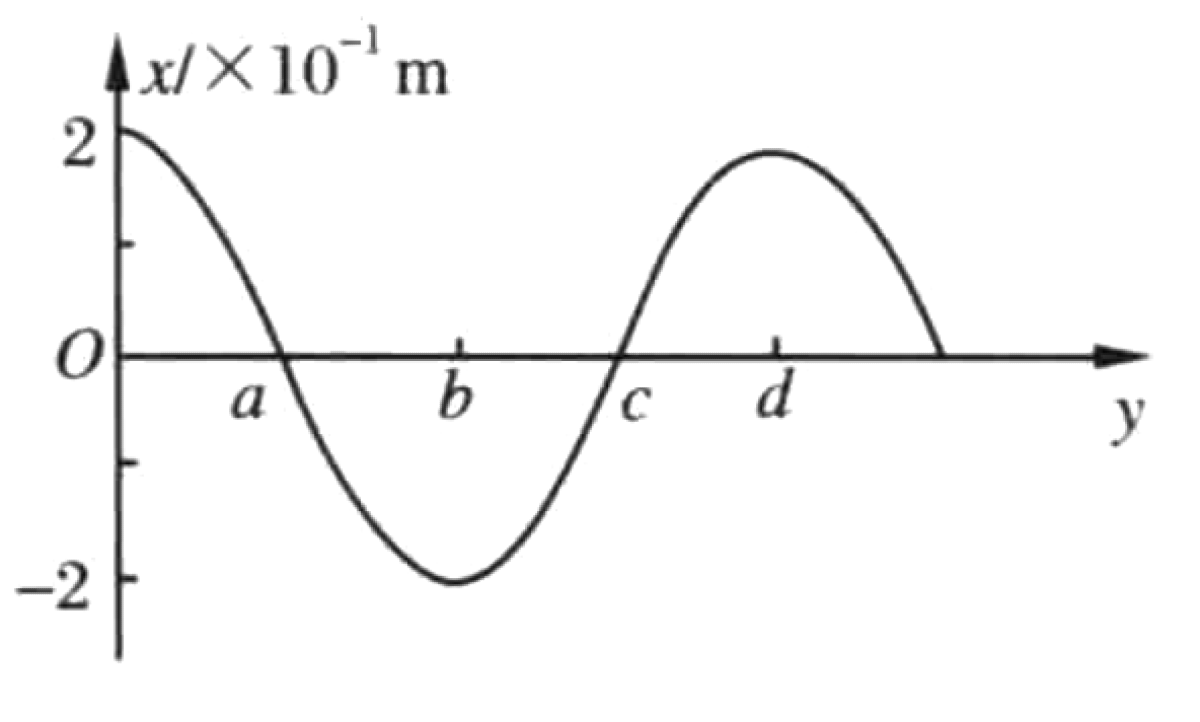
(1) Shift the waveform $3\lambda/8$ (at $t=3T/8$) and $7\lambda/6 \equiv \lambda/6$ (at $t=7T/6$) in $+y$. (2) For $-y$ propagation, shift the same waveform $3\lambda/8$ and $\lambda/6$ in $-y$. (3) With $A = 0.2$ m and $\omega = 2\pi/T$: $x_O = A\sin(\omega t + \tfrac{\pi}{2})$, $x_a = A\sin(\omega t)$, $x_b = A\sin(\omega t - \tfrac{\pi}{2})$, $x_c = A\sin(\omega t + \pi)$, $x_d = A\sin(\omega t + \tfrac{\pi}{2})$.
A traveling wave keeps its shape and shifts along the propagation direction by $\Delta y = v\,t = \dfrac{\lambda}{T}\,t$ in time $t$.
(1) At $t = 3T/8$ the pattern shifts in $+y$ by
$$\Delta y = \frac{\lambda}{T}\cdot\frac{3T}{8} = \frac{3\lambda}{8},$$so the crest originally at $O$ moves to $y = 3\lambda/8$. At $t = 7T/6$ the shift is
$$\Delta y = \frac{\lambda}{T}\cdot\frac{7T}{6} = \frac{7\lambda}{6} = \lambda + \frac{\lambda}{6};$$a shift of one full wavelength reproduces the wave, so the pattern appears shifted by only $\lambda/6$ in $+y$.
(2) For $-y$ propagation the same shape shifts the opposite way: the waveforms are obtained by shifting the original $3\lambda/8$ and $\lambda/6$ in the $-y$ direction (mirror images about the $y$-axis of the $+y$ results).
(3) Each particle performs SHM with $\omega = \dfrac{2\pi}{T}$ and amplitude $A = 0.2$ m. For a wave moving in $+y$, a particle's velocity matches that of the particle just behind it (smaller $y$), which fixes each initial phase:
- $O$ (crest, $x = +A$, momentarily at rest, about to move down): $x_O = A\sin\!\left(\omega t + \dfrac{\pi}{2}\right)$.
- $a$ ($x = 0$, moving up): $x_a = A\sin(\omega t)$.
- $b$ (trough, $x = -A$, about to move up): $x_b = A\sin\!\left(\omega t - \dfrac{\pi}{2}\right)$.
- $c$ ($x = 0$, moving down): $x_c = A\sin(\omega t + \pi)$.
- $d$ (crest, same phase as $O$): $x_d = A\sin\!\left(\omega t + \dfrac{\pi}{2}\right)$.