Source: High school physics (Chinese)
Problem Sets:
Problem
The figure shows the vibration graph of object A undergoing simple harmonic motion: displacement $x$ (in cm) versus time $t$ (in units of 0.1 s). The curve is a sine that leaves the origin rising, reaches $+10$ cm at $t = 0.1$ s, returns to zero at $t = 0.2$ s, reaches $-10$ cm at $t = 0.3$ s, and completes one full cycle at $t = 0.4$ s.
- For object A, find the amplitude, period, frequency, and angular frequency. Write the displacement-time expression and state the value of the initial phase.
- Object B undergoes simple harmonic motion with amplitude 1.5 times that of A, frequency twice that of A, and the same initial phase as A. Sketch B's vibration graph relative to A's.
- Object C undergoes simple harmonic motion with the same frequency as A, amplitude 1.5 times that of A, and an initial phase $\pi/2$ greater than A's. Sketch C's vibration graph and write its displacement-time expression. Then determine the graph and the expression if instead C's initial phase were $2\pi/3$ less than A's.
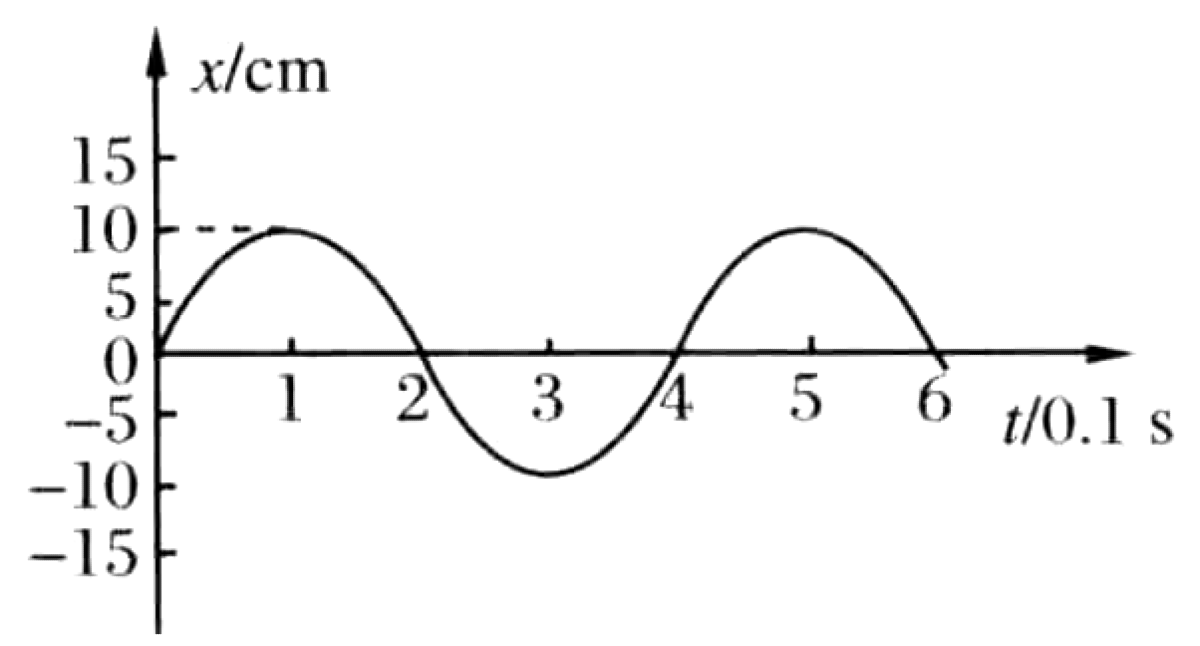
Object A: $A = 10$ cm, $T = 0.4$ s, $f = 2.5$ Hz, $\omega = 5\pi \approx 15.7$ rad/s, initial phase $\varphi_0 = 0$, and $x = 10\sin(5\pi t)$ cm. Object B: $x_B = 15\sin(10\pi t)$ cm. Object C (phase $+\pi/2$): $x_C = 15\cos(5\pi t)$ cm. Object C (phase $-2\pi/3$): $x_C = 15\sin\left(5\pi t - \dfrac{2\pi}{3}\right)$ cm.
Object A. From the graph the amplitude is $A = 10$ cm. One complete cycle spans four 0.1 s divisions, so the period is $T = 0.4$ s. Hence $f = 1/T = 2.5$ Hz and $\omega = 2\pi f = 5\pi \approx 15.7$ rad/s. The curve leaves the origin moving in the $+x$ direction, so $x = A\sin\omega t$, giving $x = 10\sin(5\pi t)$ cm with initial phase $\varphi_0 = 0$.
Object B. Amplitude $A_B = 1.5 \times 10 = 15$ cm; frequency $f_B = 2f = 5$ Hz, so $T_B = 0.2$ s and $\omega_B = 10\pi$ rad/s; the initial phase is unchanged. Thus $x_B = 15\sin(10\pi t)$ cm. Its graph is a sine that starts at the origin rising, with amplitude 15 cm, completing two full cycles in the time A completes one.
Object C (phase $+\pi/2$). Same frequency as A, so $\omega = 5\pi$ rad/s; amplitude $A_C = 15$ cm; initial phase $\varphi_0 = \pi/2$. Then $x_C = 15\sin\left(5\pi t + \dfrac{\pi}{2}\right) = 15\cos(5\pi t)$ cm. Its graph is a cosine starting at the maximum $+15$ cm when $t = 0$.
Object C (phase $-2\pi/3$). Now $\varphi_0 = -\dfrac{2\pi}{3}$, so $x_C = 15\sin\left(5\pi t - \dfrac{2\pi}{3}\right)$ cm. At $t = 0$ the displacement is $15\sin\left(-\dfrac{2\pi}{3}\right) = -\dfrac{15\sqrt{3}}{2} \approx -13$ cm; the curve first descends to the minimum $-15$ cm (reached at $t = 1/30$ s) and then rises.