Source: High school physics (Chinese)
Problem
A magnetohydrodynamic (MHD) generator converts the internal energy of a gas directly into electrical energy. A gas is heated to a very high temperature (above 2500 K) and ionized into a plasma containing both positively and negatively charged particles. The plasma flows with steady speed $v$ between two parallel conducting plates separated by a distance $d$, in a uniform magnetic field $\vec{B}$ that is perpendicular to the flow direction and parallel to the plates. A voltage appears between the two plates.
- Explain the physical origin of the voltage between the plates.
- Prove that, in steady state, the voltage between the plates is $U = vBd$.
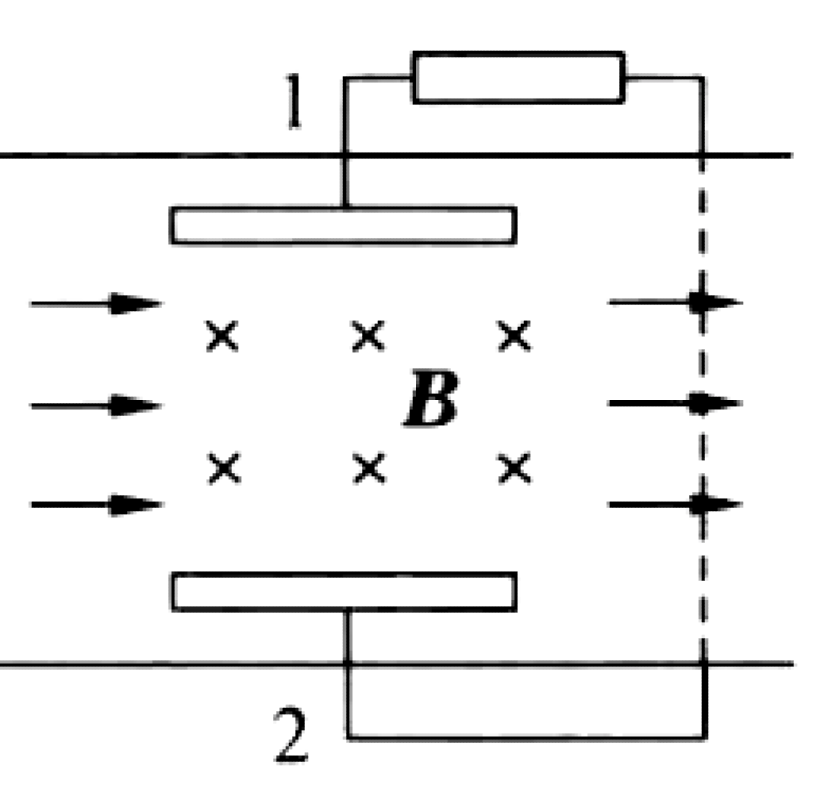
(1) As the plasma flows through the magnetic field, the Lorentz force $\vec{F} = q\vec{v} \times \vec{B}$ acts on each ion. Positive ions are pushed toward one plate and negative ions toward the opposite plate, so opposite charges accumulate on the two plates. This charge separation establishes an electric field between the plates and hence a potential difference.
(2) The accumulated charges produce an electric field $\vec{E}$ between the plates that opposes further charge separation. In steady state, the electric force on each ion balances the magnetic force:
$$qE = qvB \quad\Rightarrow\quad E = vB.$$Since the field between parallel plates is uniform, the voltage between them is
$$U = Ed = vBd. \quad\blacksquare$$