Source: High school physics (Chinese)
Problem Sets:
Problem
A device for measuring the charge-to-mass ratio of ions operates as follows. Neutral gas molecules enter an ionization chamber where they are ionized. The ions drift out through slit $S_1$ with negligible initial speed, are accelerated through a potential difference $U$, then enter a uniform magnetic field of magnitude $B$ perpendicular to their velocity through slit $S_3$. The ions undergo uniform circular motion, complete half a revolution, and strike a photographic plate at point $P$ a distance $d$ from $S_3$. The ions carry charge $q$.
When used as a mass spectrometer, ions of the same charge but different masses land at different positions $d$, producing distinct spectral lines. For parts (2) and (3), consider singly-charged magnesium ions (charge $q = 1.6 \times 10^{-19}$ C) accelerated through $U = 2000$ V and entering a magnetic field $B = 50 \times 10^{-3}$ T, with $1\,\mathrm{u} = 1.66 \times 10^{-27}$ kg.
- Prove that the charge-to-mass ratio of the ion is $\dfrac{q}{m} = \dfrac{8U}{B^2 d^2}$.
- Find the radius of the orbit of a ${}^{24}\mathrm{Mg}$ ion (mass $= 24$ u).
- Find the distance on the plate between the spectral lines of ${}^{24}\mathrm{Mg}$ and its isotope ${}^{26}\mathrm{Mg}$ (mass $= 26$ u).
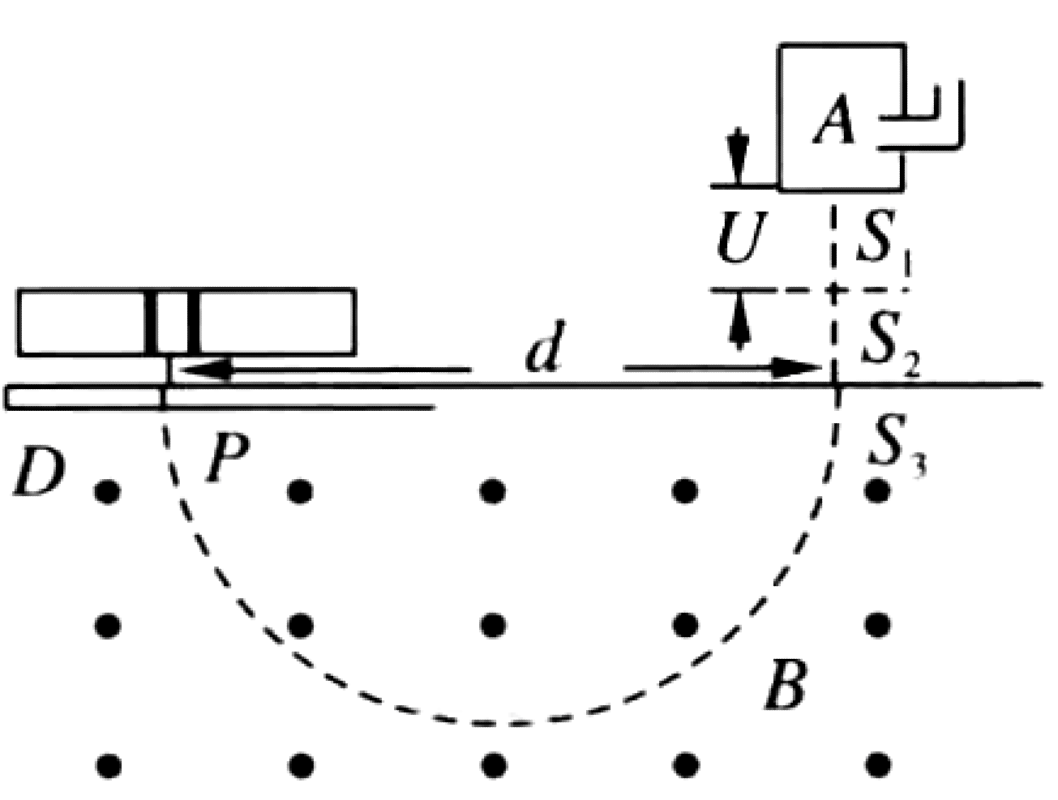
(1) Energy conservation in the accelerating field (starting from rest) gives $qU = \tfrac{1}{2}mv^2$, so $v = \sqrt{2qU/m}$. The Lorentz force supplies the centripetal force, $qvB = mv^2/r$, giving $r = mv/(qB)$. After half a revolution the ion lands a diameter away: $d = 2r = (2/B)\sqrt{2mU/q}$. Squaring and solving:
$$\dfrac{q}{m} = \dfrac{8U}{B^2 d^2}.$$(2) From the derivation, $r = \dfrac{1}{B}\sqrt{2mU/q}$. For ${}^{24}\mathrm{Mg}$ with $m_1 = 24 \times 1.66 \times 10^{-27}$ kg $= 3.98 \times 10^{-26}$ kg:
$$r_1 = \dfrac{1}{0.05}\sqrt{\dfrac{2(3.98 \times 10^{-26})(2000)}{1.6 \times 10^{-19}}} \approx 0.631 \text{ m}.$$(3) Since $r \propto \sqrt{m}$ for fixed $q$, $U$, $B$:
$$\dfrac{r_2}{r_1} = \sqrt{\dfrac{26}{24}} \approx 1.041 \quad\Rightarrow\quad r_2 \approx 0.657 \text{ m}.$$Each ion lands at $d = 2r$, so the spectral-line separation is
$$\Delta d = 2(r_2 - r_1) \approx 0.052 \text{ m} \approx 5.2 \text{ cm}.$$