Source: High school physics (Chinese)
Problem Sets:
Problem
A diagram shows trajectories of electrons and positrons emitted from a common point $O$ in a uniform magnetic field $\vec{B}$ directed into the page. Five trajectories labeled $a$, $b$, $c$, $d$, $e$ all originate from $O$; trajectories $a$, $b$, $c$ curve to one side ($c$ has the largest radius, $a$ the smallest), while trajectories $d$ and $e$ curve to the opposite side.
- Which trajectories belong to electrons and which belong to positrons?
- Among the three trajectories $a$, $b$, $c$, which particle has the largest energy and which has the smallest?
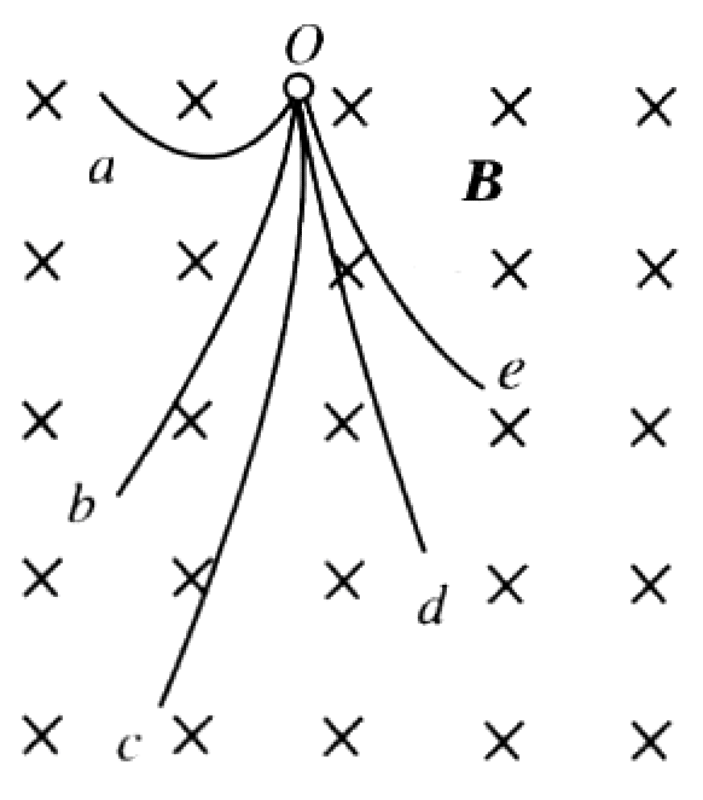
By the Lorentz force $\vec{F} = q\vec{v} \times \vec{B}$, particles of opposite charge curve in opposite directions. With $\vec{B}$ into the page, trajectories $a$, $b$, $c$ correspond to negatively charged particles (electrons) and trajectories $d$, $e$ correspond to positively charged particles (positrons).
The radius of circular motion in a magnetic field is $r = \dfrac{mv}{qB}$, so the kinetic energy is
$$E_k = \dfrac{1}{2}mv^2 = \dfrac{(qBr)^2}{2m}.$$For the same charge and field, larger $r$ corresponds to larger $E_k$. Therefore trajectory $c$ has the largest energy and trajectory $a$ has the smallest.