Source: High school physics (Chinese)
Problem
Two infinite straight wires are perpendicular to each other but do not intersect; their minimum separation is $d = 2.0 \text{ cm}$. They carry currents $I_1 = 4.0$ A and $I_2 = 6.0$ A. Point $P$ in the field lies at perpendicular distance $d$ from each wire. Find the magnitude of the magnetic flux density $\vec{B}$ at $P$.
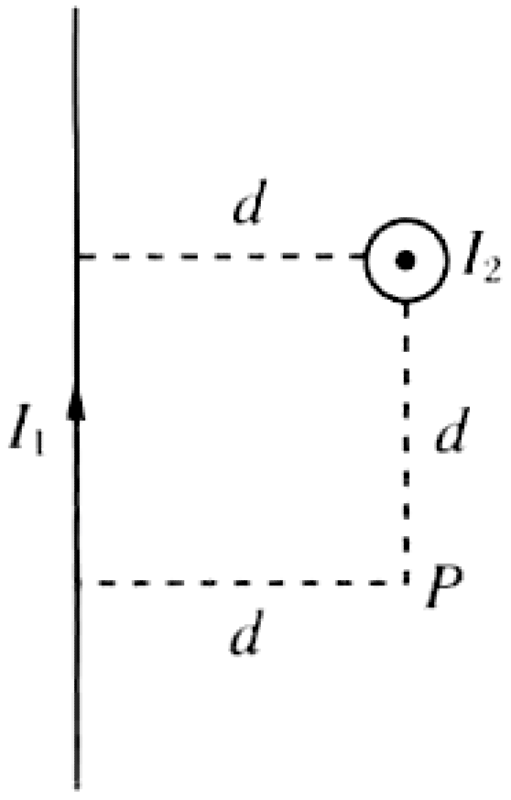
The direction lies in the plane spanned by $\vec{B}_1$ and $\vec{B}_2$, making an angle $\arctan(B_1/B_2) = \arctan(2/3) \approx 33.7°$ from $\vec{B}_2$ toward $\vec{B}_1$.
Each wire contributes $B_i = \dfrac{\mu_0 I_i}{2\pi d}$ at $P$. Because the wires are mutually perpendicular and each is perpendicular to the corresponding radial direction at $P$, the two field vectors $\vec{B}_1$ and $\vec{B}_2$ are mutually perpendicular (one lies along the axis of the other wire's direction, the other lies in the plane perpendicular to that axis).
Magnitudes:
$$B_1 = \frac{\mu_0 I_1}{2\pi d} = \frac{(2\times10^{-7})(4.0)}{0.020} = 4.0\times10^{-5}\text{ T}$$ $$B_2 = \frac{\mu_0 I_2}{2\pi d} = \frac{(2\times10^{-7})(6.0)}{0.020} = 6.0\times10^{-5}\text{ T}$$Since $\vec{B}_1 \perp \vec{B}_2$:
$$B = \sqrt{B_1^2 + B_2^2} = \sqrt{4.0^2 + 6.0^2}\times10^{-5} = \sqrt{52}\times10^{-5} \approx 7.2\times10^{-5}\text{ T}$$