Source: High school physics (Chinese)
Problem Sets:
Problem
Two long straight current-carrying wires lie in the $xOy$ plane, both carrying current $I = 20$ A in the $-x$ direction. The wires are parallel to the $x$-axis, one at $y = -6 \text{ cm}$ and the other at $y = +6 \text{ cm}$.
- Find the magnitude and direction of the magnetic flux density on the $y$-axis at $y = -3 \text{ cm}$.
- Find the magnitude and direction of the magnetic flux density on the $y$-axis at $y = +3 \text{ cm}$.
- Find the force per unit length that one wire exerts on the other.
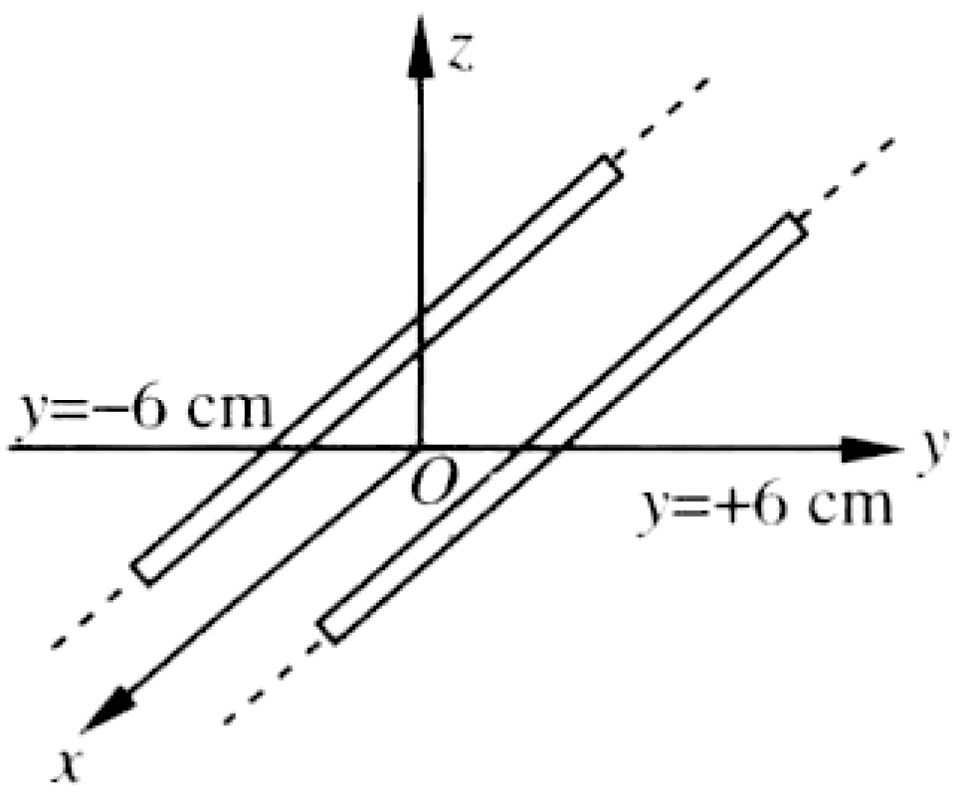
(1) $B \approx 8.89\times10^{-5}$ T, in the $-z$ direction.
(2) $B \approx 8.89\times10^{-5}$ T, in the $+z$ direction.
(3) $\dfrac{F}{\ell} \approx 6.67\times10^{-4}$ N/m, attractive (each wire is pulled toward the other).
For each wire, $B = \dfrac{\mu_0 I}{2\pi r}$, with direction $\hat{B} = \hat{I} \times \hat{r}_\perp$ (right-hand rule). With $\hat{I} = -\hat{x}$:
- A field point at $+y$ from the wire $\Rightarrow$ $\hat{B} = -\hat{x}\times\hat{y} = -\hat{z}$ (downward, $-z$).
- A field point at $-y$ from the wire $\Rightarrow$ $\hat{B} = -\hat{x}\times(-\hat{y}) = +\hat{z}$ (upward, $+z$).
Let $C \equiv \dfrac{\mu_0 I}{2\pi} = (2\times10^{-7})(20) = 4\times10^{-6}\text{ T·m}$.
(1) At $P=(0,-3,0)$ cm:
- From wire at $y=-6$ (distance $r_1=3$ cm, $P$ is at $+y$): $\vec{B}_1 = -\dfrac{C}{r_1}\hat{z}$, magnitude $1.33\times10^{-4}$ T.
- From wire at $y=+6$ (distance $r_2=9$ cm, $P$ is at $-y$): $\vec{B}_2 = +\dfrac{C}{r_2}\hat{z}$, magnitude $4.44\times10^{-5}$ T.
(2) At $P=(0,+3,0)$ cm: distances swap ($r_1=9$ cm, $r_2=3$ cm) and signs reverse, giving $\vec{B} \approx +8.89\times10^{-5}\,\hat{z}$ T.
(3) Force per unit length between the two parallel wires (separation $D = 12 \text{ cm}$):
$$\frac{F}{\ell} = \frac{\mu_0 I_1 I_2}{2\pi D} = \frac{(2\times10^{-7})(20)(20)}{0.12} \approx 6.67\times10^{-4}\text{ N/m}$$Because both currents flow in the same direction, the wires attract each other.