Source: High school physics (Chinese)
Problem
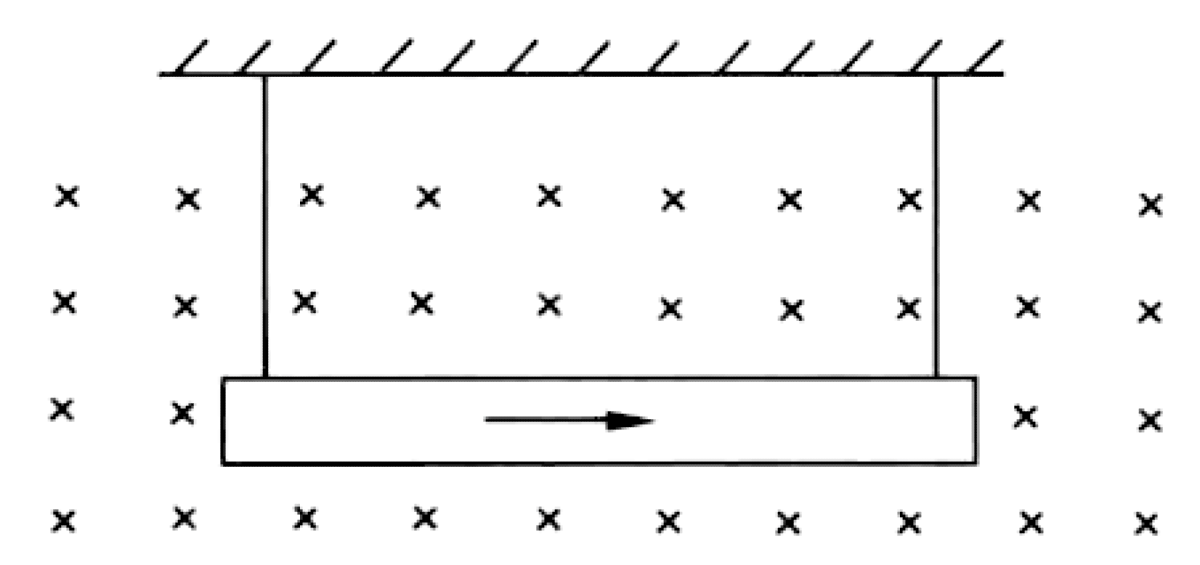
A straight wire of length $l$ and mass $m$ hangs horizontally on thin strings in a uniform external magnetic field $\vec{B}$. The current $I$ in the wire is perpendicular to $\vec{B}$.
- Find the current $I$ that reduces the tension in the strings to zero.
- Evaluate $I$ for $l = 50$ cm, $m = 10$ g, $B = 1.0$ T (use $g = 9.8\ \text{m}/\text{s}^2$).
- Under what conditions will the wire move upward?
(1) $I = \dfrac{mg}{Bl}$.
(2) $I \approx 0.20$ A (about $0.196$ A).
(3) The wire moves upward when the Ampere force is directed upward (i.e. the current direction relative to $\vec{B}$ is chosen so that $I\vec{L}\times\vec{B}$ points up) and $I > \dfrac{mg}{Bl}$.
Forces on the wire: weight $mg$ (downward), Ampere force $F_B = BIl$ (direction determined by the left-hand rule), and string tension $T$ (upward, when present).
For the tension to vanish, the Ampere force must support the wire's weight:
$$BIl = mg \quad\Longrightarrow\quad I = \frac{mg}{Bl}.$$For the wire to accelerate upward, the upward Ampere force must exceed the weight, i.e. $BIl > mg$, or $I > mg/(Bl)$; in addition the current direction (relative to $\vec{B}$) must be such that the Ampere force points upward.
Numerical evaluation with $m = 0.010$ kg, $l = 0.50$ m, $B = 1.0$ T, $g = 9.8\ \text{m}/\text{s}^2$:
$$I = \frac{0.010 \times 9.8}{1.0 \times 0.50} = \frac{0.098}{0.50} = 0.196\ \text{A} \approx 0.20\ \text{A}.$$