Source: High school physics (Chinese)
Problem
As shown in Figure, a current-carrying loop is placed in the uniform field between the poles of a permanent magnet.
- In figure (a), with the N pole on the left and the S pole on the right, describe how the coil rotates.
- In figure (b), the coil rotates clockwise when viewed from above. Identify which side of the magnet is the N pole and which is the S pole.
- In figure (c), with the S pole on the left and the N pole on the right, the coil rotates counterclockwise when viewed from above. Determine the direction of the current circulating in the coil.
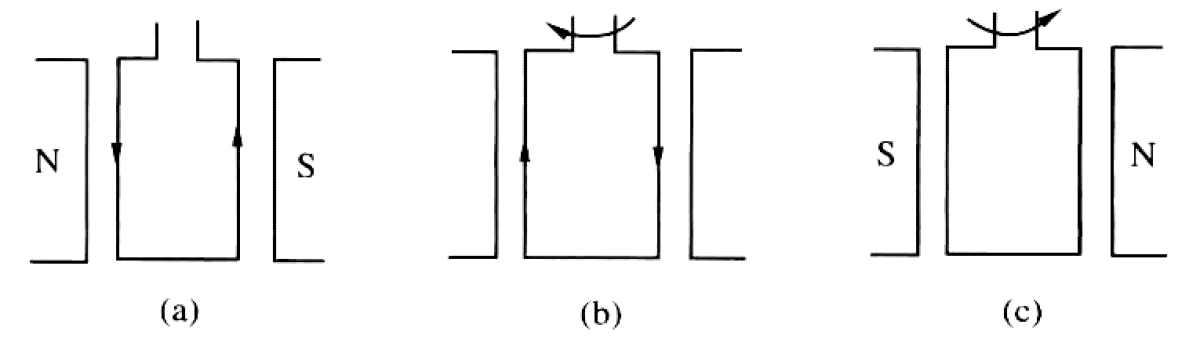
The coil always rotates so that its magnetic moment $\vec{m}$ aligns parallel to $\vec{B}$ (which points from N to S inside the gap).
(1) The coil rotates about its vertical central axis until $\vec{m}$ points from left (N) to right (S).
(2) The N pole is on the side toward which $\vec{m}$ rotates (i.e. the side from which $\vec{B}$ emerges); the opposite side is S. Concretely, applying the right-hand rule to the current shown in (b) gives $\vec{m}$; clockwise rotation (viewed from above) then identifies which side $\vec{B}$ points toward (S) and which it points away from (N).
(3) The current direction is fixed by the right-hand rule applied to the magnetic moment $\vec{m}$, which must be oriented so that $\vec{m}\times\vec{B}$ (with $\vec{B}$ pointing from right to left) produces an upward torque (counterclockwise rotation viewed from above).
Inside the gap between the poles, $\vec{B}$ points from the N pole to the S pole. The loop's magnetic moment $\vec{m} = I\vec{A}$ is normal to the loop plane (right-hand rule from the current). The torque $\vec{\tau} = \vec{m}\times\vec{B}$ rotates the loop about its vertical central axis until $\vec{m}\parallel\vec{B}$.
(1) $\vec{B}$ points from left (N) to right (S). The coil rotates about its vertical central axis so that $\vec{m}$ swings around to point to the right, parallel to $\vec{B}$.
(2) When viewed from above, the sense of rotation is given by the sign of $\vec{m}\times\vec{B}$. With the current circulating in the sense shown in figure (b), the magnetic moment $\vec{m}$ has a definite horizontal direction (by the right-hand rule); for clockwise rotation viewed from above, $\vec{B}$ must point so that $\vec{m}\times\vec{B}$ is directed downward at the start. The N pole is therefore the side from which $\vec{B}$ emerges (i.e. the pole that $\vec{m}$ must rotate toward).
(3) With N on the right and S on the left, $\vec{B}$ points horizontally from right to left. For counterclockwise rotation viewed from above, $\vec{m}\times\vec{B}$ must point upward at the start, which fixes $\vec{m}$ to point horizontally out of the page (toward the viewer from above's perspective, this is the direction perpendicular to $\vec{B}$ that gives the correct cross product sense). By the right-hand rule, the current then circulates in the corresponding sense around the coil.