Source: High school physics (Chinese)
Problem
Figure shows three current-carrying coils placed in a uniform magnetic field $\vec{B}$. For each coil, determine how it will rotate and the orientation of its rotation axis.
- Left diagram: A rectangular coil lies with its plane perpendicular to $\vec{B}$ (which points out of the page), with current $I$ circulating as shown. Describe its motion.
- Middle diagram: A rectangular coil lies with its plane perpendicular to $\vec{B}$ (which points into the page), with current $I$ circulating as shown. Describe its motion.
- Right diagram: A rectangular coil lies with its plane parallel to $\vec{B}$ (which points upward in the plane of the coil), with current $I$ circulating as shown. Describe its motion.
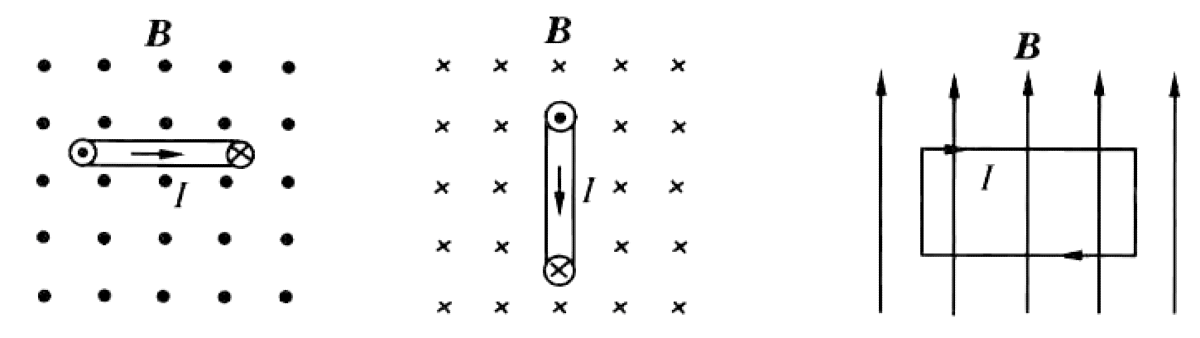
The rotation axis always passes through the centre of the coil, lies in the plane of the coil, and is perpendicular to $\vec{B}$; the coil rotates until $\vec{m}=I\vec{A}$ aligns parallel to $\vec{B}$.
(1) The coil is already in equilibrium and does not rotate (stable if $\vec{m}\parallel\vec{B}$; if antiparallel, the slightest perturbation causes a $180^{\circ}$ flip).
(2) Same as (1): equilibrium; rotates only if perturbed from an antiparallel orientation.
(3) The coil rotates about a horizontal axis in its plane that is perpendicular to $\vec{B}$, until $\vec{m}\parallel\vec{B}$.
A current loop in a uniform field experiences a torque $\vec{\tau} = \vec{m}\times\vec{B}$, where the magnetic moment $\vec{m} = I\vec{A}$ is directed perpendicular to the coil plane (right-hand rule from the current). The loop rotates until $\vec{m}$ aligns parallel to $\vec{B}$; the rotation axis passes through the centre of the coil, lies in the plane of the coil, and is perpendicular to $\vec{B}$.
(1) and (2) The magnetic moment $\vec{m}$ is parallel (or antiparallel) to $\vec{B}$. The net torque is zero, so the coil is in equilibrium (stable if $\vec{m}\parallel\vec{B}$, unstable if $\vec{m}$ is antiparallel to $\vec{B}$ — in that case any small perturbation causes a half-turn until alignment).
(3) Here $\vec{m}\perp\vec{B}$, so the torque is maximum. The two horizontal sides of the coil carry equal and opposite currents and experience equal-and-opposite Ampere forces, producing a couple that rotates the coil about a horizontal axis through its centre, lying in the plane of the coil and parallel to those horizontal sides (i.e. perpendicular to $\vec{B}$). The coil swings until $\vec{m}$ becomes parallel to $\vec{B}$.