Source: High school physics (Chinese)
Problem Sets:
Problem
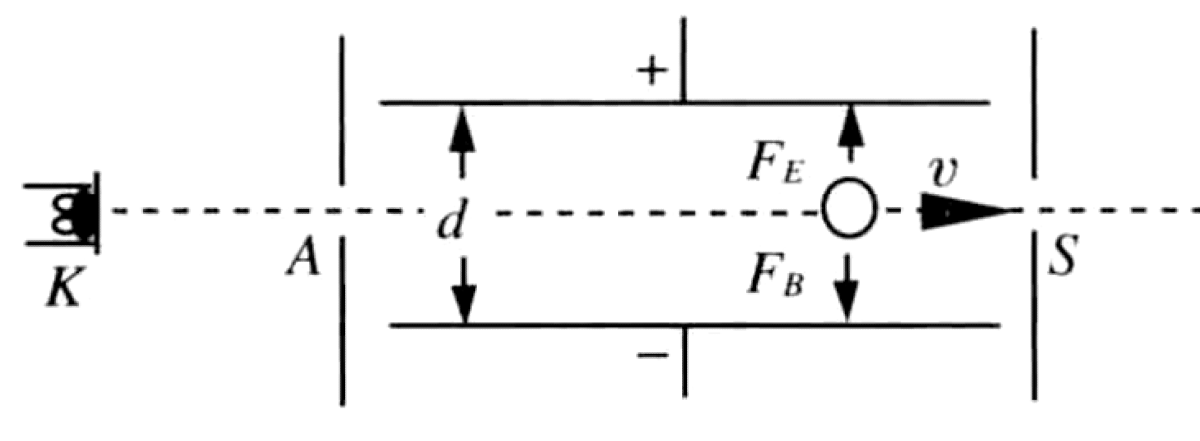
A velocity selector consists of a parallel-plate capacitor producing a uniform electric field, together with a uniform magnetic field perpendicular to the electric field (and perpendicular to the page). Electrons emitted from an electron gun $K$ along direction $KA$ enter the region with a range of speeds. Only electrons of a specific speed travel in a straight line and pass through the small hole $S$. The upper plate is at the positive terminal and the lower plate is at the negative terminal; the electrons move horizontally from left to right. The voltage between the plates is $U = 300$ V, the plate separation is $d = 5$ cm, and the magnitude of the magnetic field is $B = 6\times 10^{-2}$ T.
- Should the magnetic field point into the page or out of the page?
- What is the speed of the electrons that can pass through the hole $S$?
- If the particles passing through the selector are positively charged (instead of electrons), is it necessary to reverse the direction of either the magnetic field or the electric field? Is the speed of those particles passing through $S$ different from the electron speed found in (2)?
Q1: $\vec{B}$ points into the page. Q2: $v = E/B = U/(dB) = 1\times 10^{5}$ m/s. Q3: Neither field needs to be reversed; the selected speed is the same, $v = 1\times 10^{5}$ m/s.
For a particle to travel in a straight line, the electric force $\vec{F}_E$ and the magnetic force $\vec{F}_B$ must cancel. With the upper plate positive, $\vec{E}$ points downward (from $+$ to $-$). The electric force on the electron is $\vec{F}_E = (-e)\vec{E}$, which points upward.
Q1: $\vec{F}_B$ must point downward to cancel $\vec{F}_E$. With $\vec{v}$ pointing right and charge $-e$, we have $\vec{F}_B = -e(\vec{v}\times\vec{B})$. This is downward only if $\vec{v}\times\vec{B}$ points upward. By the right-hand rule, with $\vec{v}$ rightward, $\vec{v}\times\vec{B}$ is upward when $\vec{B}$ points INTO the page.
Q2: The balance condition $|q|E = |q|vB$ gives the selector formula
$$v = \frac{E}{B} = \frac{U/d}{B}.$$Substituting: $E = U/d = 300/0.05 = 6000$ V/m, so
$$v = \frac{6000}{6\times 10^{-2}} = 1\times 10^{5}\text{ m/s}.$$Q3: For a positive charge moving rightward with the same $\vec{E}$ (down) and $\vec{B}$ (into page), both forces reverse: the electric force is now downward and the magnetic force is now upward. They still cancel, so neither field needs to be reversed. The selector condition $v = E/B$ is independent of the sign and magnitude of the charge, so the selected speed is the same as for the electron: $v = 1\times 10^{5}$ m/s.