Source: High school physics (Chinese)
Problem
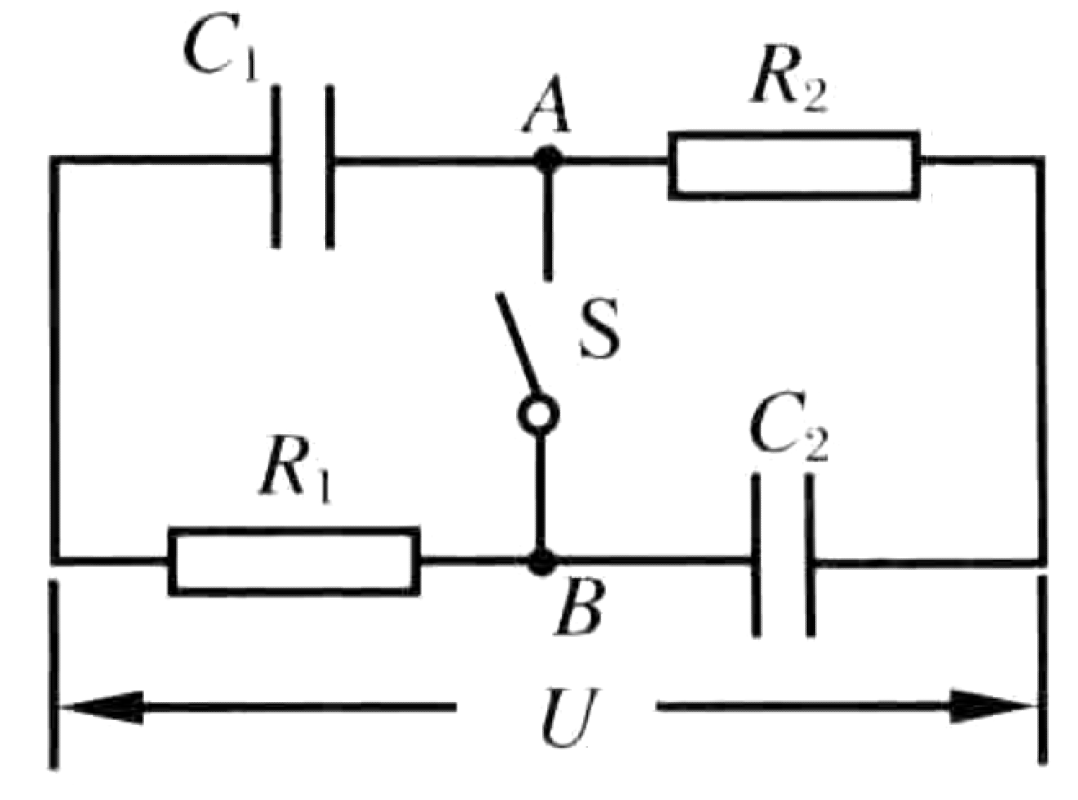
In the circuit shown, $C_1 = 6\ \mu\text{F}$, $C_2 = 3\ \mu\text{F}$, $R_1 = 6\ \Omega$, $R_2 = 3\ \Omega$, and a steady source provides $U = 18$ V between the left and right terminals. The upper branch (from the left terminal to the right terminal) consists of $C_1$ in series with $R_2$, with the junction labeled $A$. The lower branch consists of $R_1$ in series with $C_2$, with the junction labeled $B$. A switch $S$ is connected between $A$ and $B$.
- When the switch $S$ is open, find the voltage $U_{AB} = \varphi_A - \varphi_B$ between $A$ and $B$.
- When the switch is then closed, by how much (in coulombs) does the charge on capacitor $C_1$ change?
(1) $U_{AB} = -18$ V (magnitude 18 V, $B$ higher); (2) $\Delta Q_1 = -36\ \mu\text{C}$ ($C_1$'s charge decreases by $36\ \mu\text{C}$).
Take the right terminal as reference, $\varphi_R = 0$, so $\varphi_L = U = 18$ V.
\textbf{(1) Switch $S$ open.} In steady state no current flows through either branch (each contains a capacitor that blocks DC), so the voltage drop across every resistor is zero:
$$\varphi_A = \varphi_R + I R_2 = 0, \qquad \varphi_B = \varphi_L - I R_1 = 18\ \text{V}.$$Therefore
$$U_{AB} = \varphi_A - \varphi_B = 0 - 18 = -18\ \text{V}.$$(Magnitude $|U_{AB}| = 18$ V, with $B$ at the higher potential.)
The capacitor voltages before closing: $U_{C_1} = \varphi_L - \varphi_A = 18$ V, $U_{C_2} = \varphi_B - \varphi_R = 18$ V. Initial charges:
$$Q_1 = C_1 \, U_{C_1} = 6 \times 18 = 108\ \mu\text{C}.$$\textbf{(2) Switch $S$ closed.} Now $A$ and $B$ are the same node, call it $M$. In the new steady state DC current still cannot pass through the capacitors, but it flows through the resistor path $L \to R_1 \to M \to R_2 \to R$:
$$I = \frac{U}{R_1 + R_2} = \frac{18}{6 + 3} = 2\ \text{A},$$ $$\varphi_M = \varphi_L - I R_1 = 18 - 2 \times 6 = 6\ \text{V}.$$The new voltage across $C_1$:
$$U_{C_1}' = \varphi_L - \varphi_M = 18 - 6 = 12\ \text{V},$$and the new charge $Q_1' = C_1 \, U_{C_1}' = 6 \times 12 = 72\ \mu\text{C}$.
The change:
$$\Delta Q_1 = Q_1' - Q_1 = 72 - 108 = -36\ \mu\text{C}.$$The charge on $C_1$ does not increase — it \emph{decreases} by $36\ \mu\text{C}$.