Source: High school physics (Chinese)
Problem
A battery (EMF $\varepsilon$, internal resistance $r$) is in series with an ideal ammeter, forming the middle branch. Two additional branches are in parallel with this source branch: branch 1 contains $R_1 = 14.0 \Omega$ in series with switch $S_1$; branch 2 contains $R_2 = 9.0 \Omega$ in series with switch $S_2$. When only $S_1$ is closed, the ammeter reads $I_1 = 0.20 A$. When only $S_2$ is closed, it reads $I_2 = 0.30 A$.
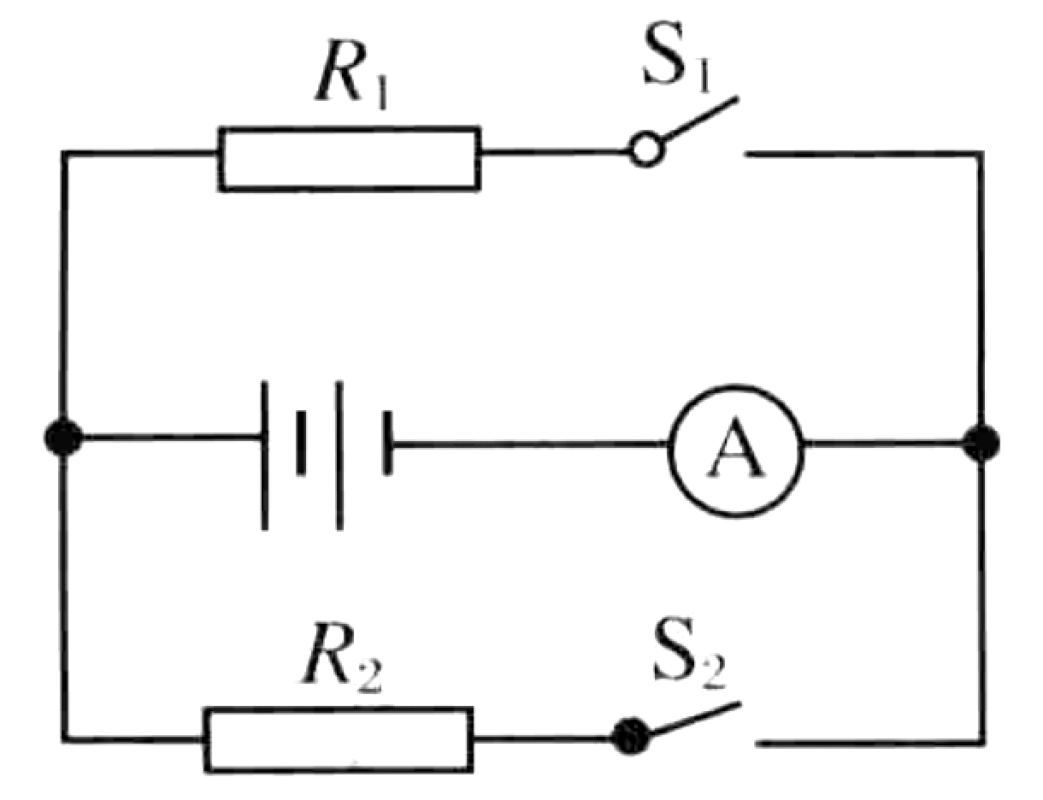
With only $S_1$ closed, the circuit is the simple loop $\varepsilon = I_1 (r + R_1)$, giving $\varepsilon = 0.20 (r + 14)$.
With only $S_2$ closed, $\varepsilon = I_2 (r + R_2) = 0.30 (r + 9)$.
Equating: $0.20 r + 2.8 = 0.30 r + 2.7$, so $r = 1.0 \Omega$ and $\varepsilon = 0.20 \times 15 = 3.0 V$.
With both switches closed, the load is $R_1 \parallel R_2 = \dfrac{R_1 R_2}{R_1 + R_2} = \dfrac{14 \times 9}{23} = \dfrac{126}{23} \Omega$.
Total circuit resistance: $r + R_1 \parallel R_2 = 1 + \dfrac{126}{23} = \dfrac{149}{23} \Omega$.
Ammeter reading (total current from battery):
$$I = \dfrac{\varepsilon}{r + R_1 \parallel R_2} = \dfrac{3.0 \times 23}{149} = \dfrac{69}{149} A \approx 0.46 A.$$