Source: High school physics (Chinese)
Problem
A control circuit has input voltage $U = 24 V$ across input terminals $AA'$. A resistor $R$ connects $A$ to a junction node $X$, which serves as the upper output terminal $B$. From $X$, two parallel branches drop to the lower rail ($A' = B'$): one through $R_1$ in series with switch $S_1$, the other through $R_2$ in series with switch $S_2$. The output voltage at $BB'$ is to be selectable among $24 V$, $12 V$, $8 V$, and $6 V$. The current through any resistor must not exceed $12 mA$.
- Find the minimum values of $R$, $R_1$, and $R_2$.
- Specify the configuration of switches $S_1$ and $S_2$ for each output voltage.
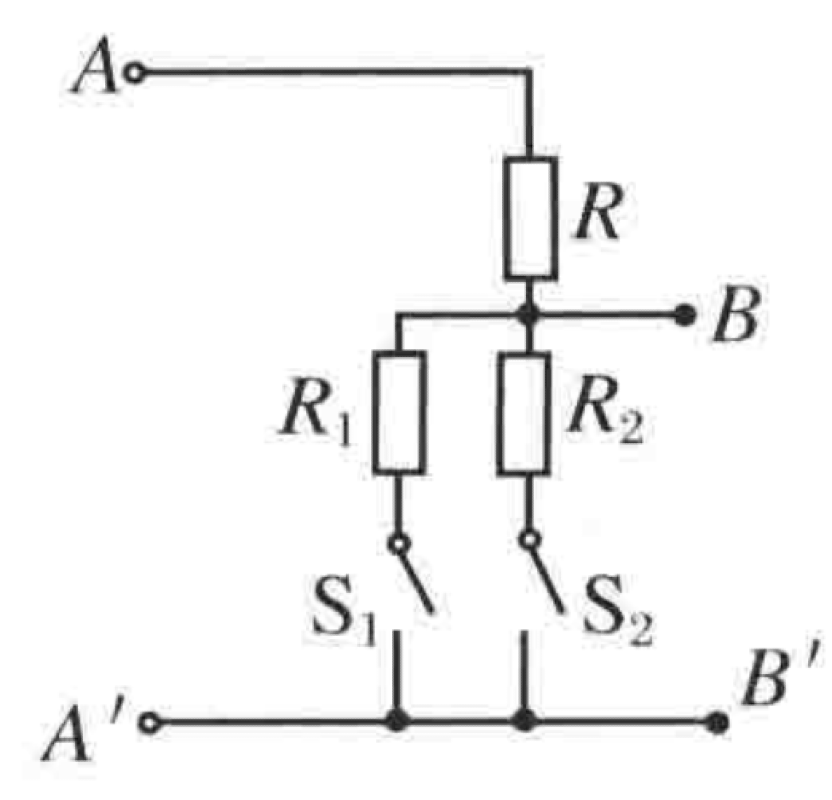
With both switches open, no current flows and $U_{BB'} = U = 24 V$.
When only $S_1$ is closed, the loop is a voltage divider: $U_{BB'} = U \dfrac{R_1}{R + R_1}$. Setting this to $12 V$ gives $R_1 = R$.
When only $S_2$ is closed: $U_{BB'} = U \dfrac{R_2}{R + R_2} = 8 V$ gives $R_2 = R/2$.
When both switches are closed: $R_{\text{eff}} = R_1 \parallel R_2 = R/3$, so $U_{BB'} = U \dfrac{R/3}{R + R/3} = 6 V$. $\checkmark$
Currents in each case (with $R_1 = R$, $R_2 = R/2$): \
- $12 V$ case: through $R$ and $R_1$ alike, $I = 24/(2R) = 12/R$.
\
- $8 V$ case: through $R$ and $R_2$ alike, $I = 24/(3R/2) = 16/R$.
\
- $6 V$ case: through $R$, $I_R = 24/(4R/3) = 18/R$; through $R_1$, $I_{R_1} = 6/R$; through $R_2$, $I_{R_2} = 12/R$.
Per-resistor maxima: $R$ peaks at $18/R$ (in the $6 V$ case); $R_2$ peaks at $16/R$ (in the $8 V$ case); $R_1$ peaks at $12/R$ (in the $12 V$ case). The binding constraint is $18/R \le 12 mA$, giving $R \ge 1500 \Omega$.
Therefore: $R_{\min} = 1500 \Omega$, $R_{1,\min} = R = 1500 \Omega$, $R_{2,\min} = R/2 = 750 \Omega$.
Switch configuration: $24 V$ — both open; $12 V$ — $S_1$ closed, $S_2$ open; $8 V$ — $S_1$ open, $S_2$ closed; $6 V$ — both closed.