Source: High school physics (Chinese)
Problem
A ladder network connects terminals $A$ (top-left) and $B$ (bottom-left). Each cell of the ladder consists of a top horizontal resistor of value $R$, a bottom horizontal resistor of value $R$, and a vertical resistor (between the top and bottom rails) of value $R$. The network has an arbitrary number of cells. The rightmost vertical resistor is $R_x$ (unknown) rather than $R$.
- For what value of $R_x$ is the total resistance between $A$ and $B$ independent of the number of cells?
- What is this total resistance?
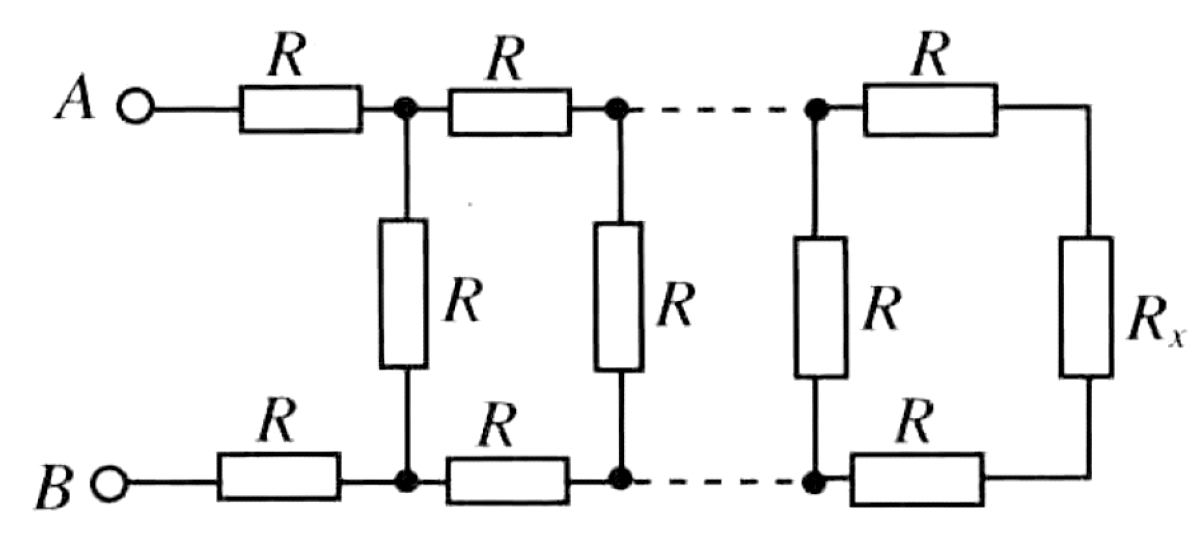
Let $R^*$ be the equivalent resistance between the top and bottom nodes at the right edge of cell $k$ (including the vertical at position $k$ and everything to its right). For self-similarity (independence of cell count), $R^*$ must satisfy:
$$R^* = R \parallel (2R + R^*) = \dfrac{R(2R + R^*)}{3R + R^*}.$$Cross-multiplying: $R^*(3R + R^*) = R(2R + R^*)$, giving
$$(R^*)^2 + 2R\,R^* - 2R^2 = 0.$$Taking the positive root: $R^* = R(\sqrt{3} - 1)$.
To anchor the network so this self-similar value holds at the right end, we set the rightmost vertical to be $R_x = R^* = R(\sqrt{3} - 1)$.
Total resistance: $R_{AB} = 2R + R^* = R(\sqrt{3} + 1)$.