Source: High school physics (Chinese)
Problem
The same galvanometer ($R_g = 100 \Omega$, $I_g = 0.1 mA$) is converted into a multi-range ammeter using an Ayrton (universal) shunt: three resistors $R_1$, $R_2$, $R_3$ are connected in series, and the galvanometer is placed in parallel across the entire string (from the leftmost node to the rightmost node). The leftmost end is the common (input) terminal. Three output taps are taken at: the node after $R_1$ ($10 A$ range), the node after $R_1 + R_2$ ($1 A$ range), and the far end after $R_3$ ($0.1 A$ range).
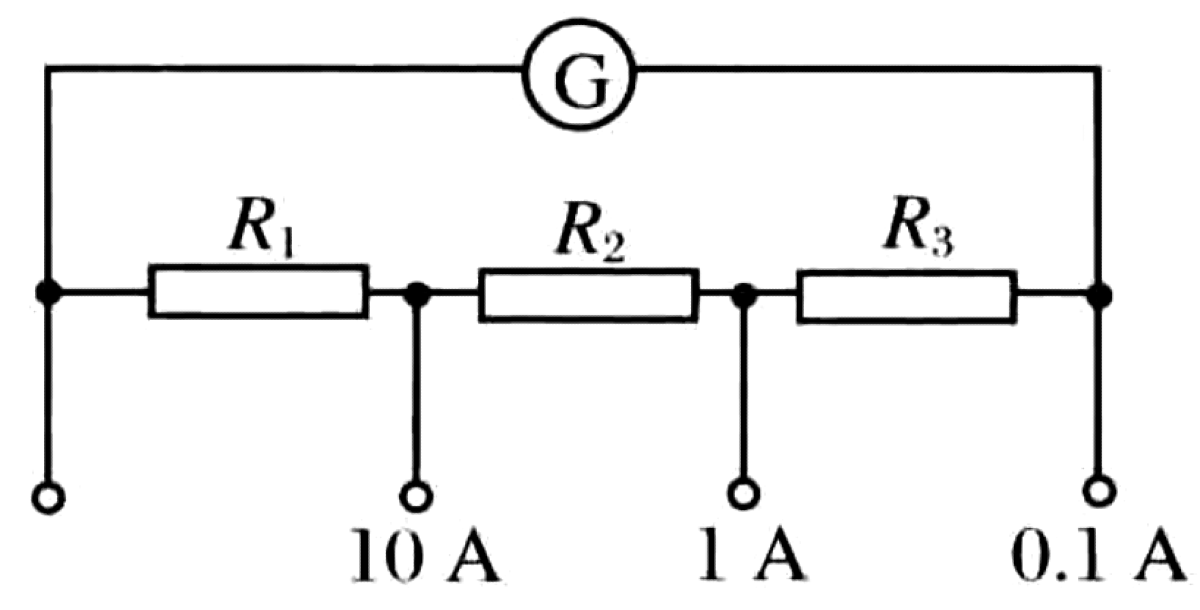
Let $R_s = R_1 + R_2 + R_3$. For an Ayrton shunt, the portion of the shunt between common and the selected tap, $R_p$, is in parallel with the galvanometer plus the remaining shunt $R_{se} = R_s - R_p$.
At full-scale: $(I - I_g) R_p = I_g (R_g + R_{se}) = I_g (R_g + R_s - R_p)$.
Solving: $R_p = \dfrac{I_g (R_g + R_s)}{I}$.
Since $I_g \ll I_{\min} = 0.1 A$ and (as shown below) $R_s \ll R_g$, this reduces to $R_p \approx I_g R_g / I$.
$10 A$ tap (after $R_1$): $R_1 = R_p = \dfrac{10^{-4} \times 100}{10} = 0.001 \Omega$. $1 A$ tap (after $R_1 + R_2$): $R_1 + R_2 = \dfrac{10^{-4} \times 100}{1} = 0.01 \Omega$, so $R_2 = 0.009 \Omega$. $0.1 A$ tap (after $R_3$): $R_1 + R_2 + R_3 = \dfrac{10^{-4} \times 100}{0.1} = 0.1 \Omega$, so $R_3 = 0.09 \Omega$. (Confirms $R_s = 0.1 \Omega \ll R_g$.)