Source: High school physics (Chinese)
Problem
A galvanometer has internal resistance $R_g = 100 \Omega$ and full-scale deflection current $I_g = 0.1 mA$. It is converted into a multi-range voltmeter by connecting three multiplier resistors $R_1$, $R_2$, $R_3$ in series with the galvanometer $G$. Three tap terminals are provided, measured against the galvanometer's far terminal: the tap after $R_1$ corresponds to the $1 V$ range, the tap after $R_1 + R_2$ corresponds to the $10 V$ range, and the tap after $R_1 + R_2 + R_3$ corresponds to the $100 V$ range.
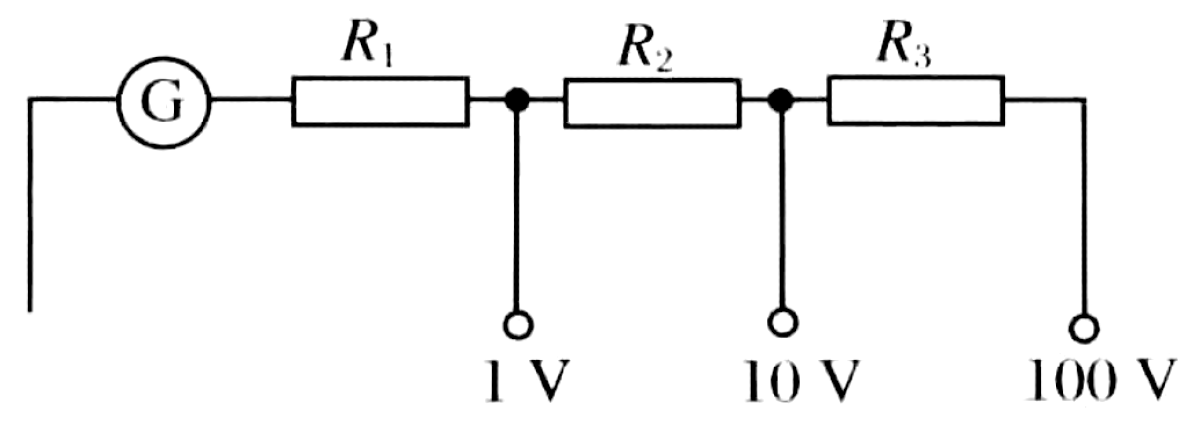
At full-scale deflection, the current $I_g$ flows through $G$ and the series multipliers up to the selected tap. The voltage between the galvanometer's far terminal and the tap equals the chosen range:
$$V_n = I_g \left( R_g + \sum_{k=1}^{n} R_k \right).$$ $1 V$ range: $1 = 10^{-4} (100 + R_1)$, so $R_1 = 10^{4} - 100 = 9900 \Omega$. $10 V$ range: $10 = 10^{-4} (100 + R_1 + R_2)$, so $R_1 + R_2 = 10^{5} - 100 = 99900 \Omega$, giving $R_2 = 90000 \Omega$. $100 V$ range: $100 = 10^{-4} (100 + R_1 + R_2 + R_3)$, so $R_1 + R_2 + R_3 = 10^{6} - 100 = 999900 \Omega$, giving $R_3 = 900000 \Omega$.