Source: High school physics (Chinese)
Problem
As shown in the figure, four resistors have values $R_1 = 2\ \Omega$, $R_2 = 3\ \Omega$, $R_3 = 4\ \Omega$, and $R_4 = 6\ \Omega$. The network is connected between two external terminals: $R_1$ lies along the upper branch and $R_2$ along the lower branch, both meeting at a pair of nodes between which $R_3$ and $R_4$ are connected in parallel. During the same time interval, the heat dissipated by each resistor is $Q_1, Q_2, Q_3, Q_4$, respectively.
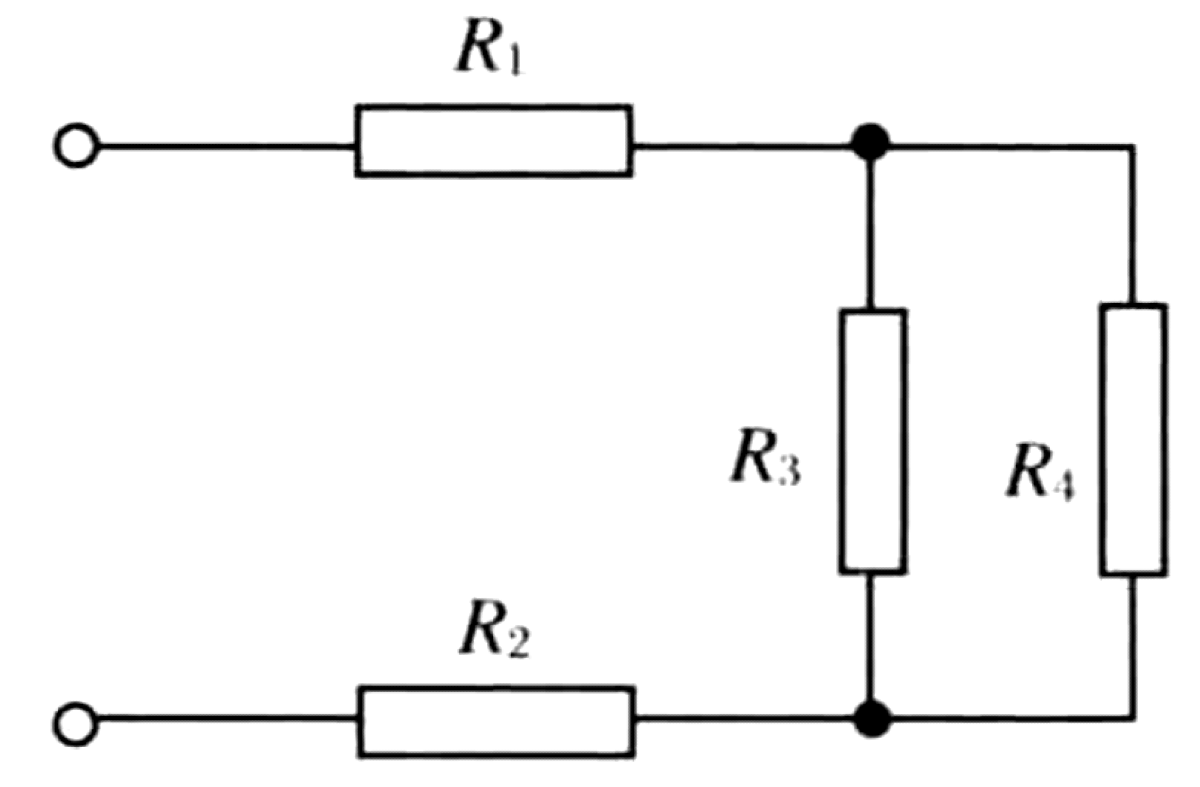
The same total current $I$ flows through $R_1$ and $R_2$ (in series), and that current then divides through the parallel pair $R_3 \parallel R_4$.
Since heat dissipated in time $t$ is $Q = I^2 R t$ for resistors carrying the same current, and equals $\dfrac{U^2}{R} t$ for resistors sharing the same voltage:
For the series pair ($R_1$, $R_2$), both carry current $I$:
$$Q_1 + Q_2 = I^2 (R_1 + R_2) t.$$For the parallel pair ($R_3$, $R_4$), the heat sums to the power dissipated in their equivalent resistance:
$$Q_3 + Q_4 = I^2 \, (R_3 \parallel R_4) \, t = I^2 \cdot \frac{R_3 R_4}{R_3 + R_4} \, t.$$Therefore
$$\frac{Q_1 + Q_2}{Q_3 + Q_4} = \frac{(R_1 + R_2)(R_3 + R_4)}{R_3 R_4} = \frac{(2 + 3)(4 + 6)}{4 \times 6} = \frac{50}{24} = \frac{25}{12}.$$