Source: High school physics (Chinese)
Problem
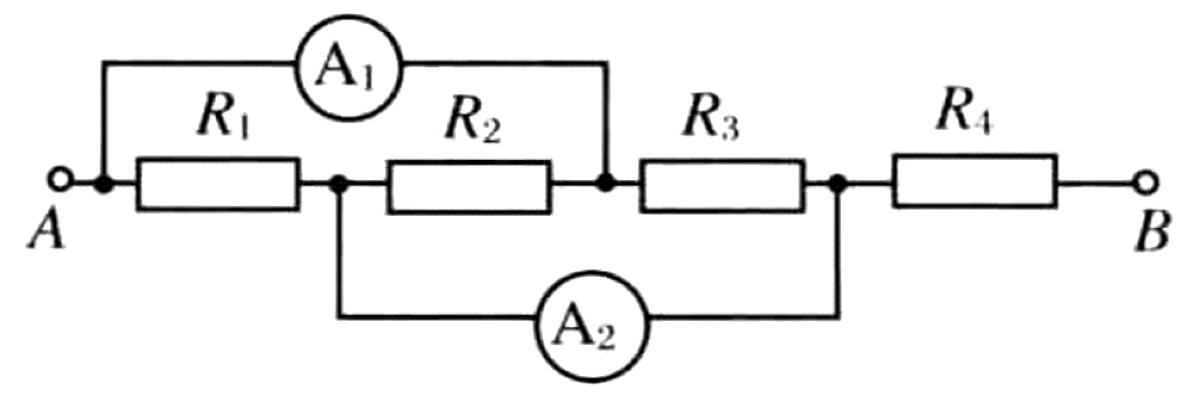
The circuit of Figure has four resistors in series between terminals $A$ and $B$, in the order $R_1 \to R_2 \to R_3 \to R_4$. The values are $R_1 = R_2 = 4$ $\Omega$, $R_3 = R_4 = 2$ $\Omega$, and the applied voltage is $U_{AB} = 6$ V. Two ideal ammeters (zero internal resistance) provide bypass paths: ammeter $A_1$ is connected from terminal $A$ to the node between $R_2$ and $R_3$ (so $A_1$ short-circuits the series pair $R_1$-$R_2$); ammeter $A_2$ is connected from the node between $R_1$ and $R_2$ to the node between $R_3$ and $R_4$ (so $A_2$ short-circuits the series pair $R_2$-$R_3$).
- Find the reading of ammeter $A_1$.
- Find the reading of ammeter $A_2$.
- Find the ratio of the voltages across $R_1$ and across $R_4$.
(1) $A_1 = 1.5$ A; \quad (2) $A_2 = 1$ A; \quad (3) $U_{R_1} : U_{R_4} = 1 : 2$.
Label the inter-resistor nodes $M_1$ (between $R_1$ and $R_2$), $M_2$ (between $R_2$ and $R_3$), $M_3$ (between $R_3$ and $R_4$). Take $V_A = 6$ V, $V_B = 0$ V.
The ideal ammeters impose $V_{M_2} = V_A = 6$ V (from $A_1$) and $V_{M_1} = V_{M_3}$ (from $A_2$). Let $V_{M_1} = V_{M_3} = V$.
KCL at $M_3$ (currents into $M_3$ from $A_2$ and $R_3$ equal the current out through $R_4$):
$$I_{A_2} + \frac{V_{M_2} - V}{R_3} = \frac{V}{R_4} \;\Rightarrow\; I_{A_2} = \frac{V}{2} - \frac{6-V}{2} = V - 3$$KCL at $M_1$ (currents into $M_1$ from $R_1$ and $R_2$ equal the current out through $A_2$):
$$\frac{6-V}{4} + \frac{6-V}{4} = V - 3 \;\Rightarrow\; \frac{6-V}{2} = V - 3 \;\Rightarrow\; V = 4 \text{ V}$$So $V_{M_1} = V_{M_3} = 4$ V, and individual currents:
$$I_{R_1} = \frac{6-4}{4} = 0.5 \text{ A}, \quad I_{R_4} = \frac{4}{2} = 2 \text{ A}, \quad I_{R_3} = \frac{6-4}{2} = 1 \text{ A}$$Current through $R_2$ flows from $M_2$ ($6$ V) to $M_1$ ($4$ V) at magnitude $0.5$ A.
(1) $A_1$ reading. KCL at $M_2$: current in from $A_1$ supplies the two outgoing branches ($0.5$ A through $R_2$ to $M_1$, $1$ A through $R_3$ to $M_3$):
$$I_{A_1} = 0.5 + 1 = 1.5 \text{ A}$$(2) $A_2$ reading. From above, $I_{A_2} = V - 3 = 1$ A.
(3) Voltage ratio.
$$U_{R_1} = I_{R_1} R_1 = 0.5 \times 4 = 2 \text{ V}, \quad U_{R_4} = I_{R_4} R_4 = 2 \times 2 = 4 \text{ V}$$ $$\frac{U_{R_1}}{U_{R_4}} = \frac{2}{4} = \frac{1}{2}$$