Source: High school physics (Chinese)
Problem
A slide rheostat of total resistance $R = 3 \text{ k}\Omega$ has its two end terminals $A$ (top) and $C$ (bottom) connected to a $U = 10 \text{ V}$ source. A load resistor $R_3 = 3 \text{ k}\Omega$ is connected between the sliding contact $B$ and the lower terminal $C$, so that $R_3$ is in parallel with the lower portion $BC$ of the rheostat.
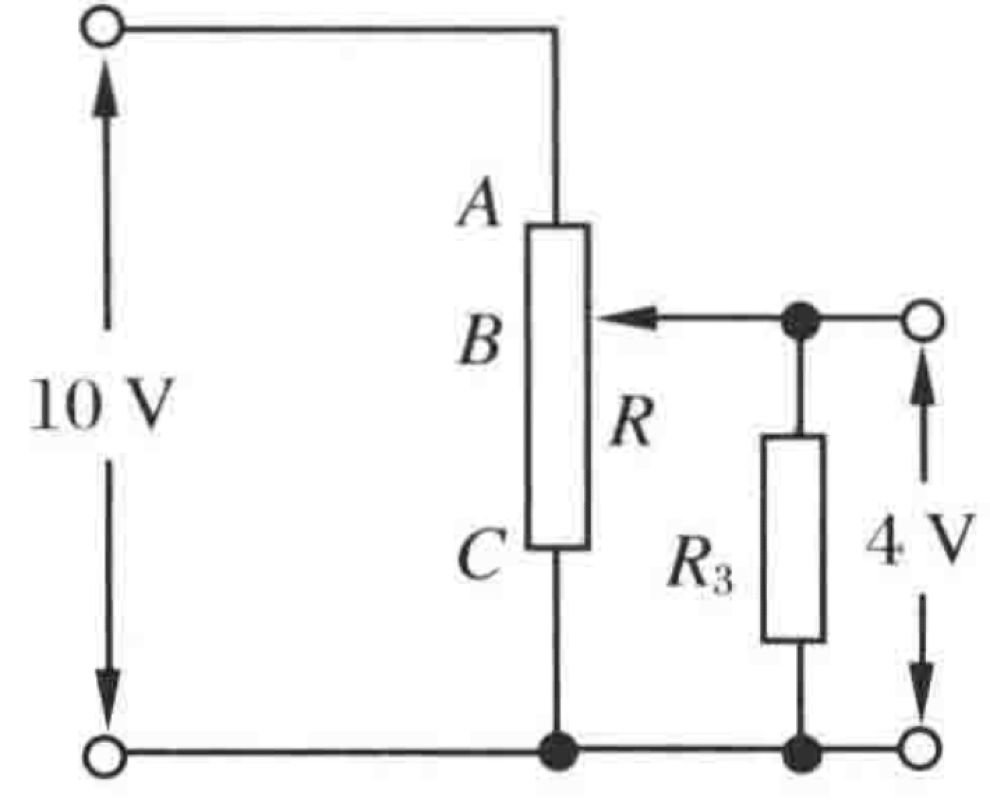
The slider $B$ should be at the midpoint of the rheostat, with $R_{BC} = 1.5 \text{ k}\Omega$ (and $R_{AB} = 1.5 \text{ k}\Omega$).
Let $R_{BC} = x$ (in k$\Omega$); then $R_{AB} = 3 - x$. The parallel combination of $R_3$ and $R_{BC}$ has resistance
$$R_{\parallel} = \frac{R_3 \, x}{R_3 + x} = \frac{3x}{x+3}.$$The voltage across this parallel block equals the voltage across $R_3$, namely $4 \text{ V}$, so the voltage across $R_{AB}$ is $10 - 4 = 6 \text{ V}$. The current drawn from the source is
$$I = \frac{6}{3-x} \text{ mA},$$and the same current flows through $R_{\parallel}$, giving
$$\frac{6}{3-x} \cdot \frac{3x}{x+3} = 4.$$Simplifying: $18x = 4(9 - x^2)$, i.e. $2x^2 + 9x - 18 = 0$. The positive root is
$$x = \frac{-9 + \sqrt{81 + 144}}{4} = \frac{-9 + 15}{4} = 1.5 \text{ k}\Omega.$$Since the rheostat winding is uniform, $R_{BC} = 1.5 \text{ k}\Omega = R/2$ means the slider sits exactly at the midpoint of the rheostat.