Source: High school physics (Chinese)
Problem
A battery with EMF $\mathcal{E}$ and internal resistance $r$ is connected to a circuit consisting of two parallel branches: branch 1 contains resistor $R_1$, and branch 2 contains resistor $R_2$ in series with a slide rheostat $R_3$. Ammeter $A_1$ is in series with the battery (measuring the total current), and ammeter $A_2$ is in the $R_2$-$R_3$ branch. Voltmeter $V$ reads the battery terminal voltage, voltmeter $V_1$ reads the voltage across $R_1$, and voltmeter $V_2$ reads the voltage across $R_3$.
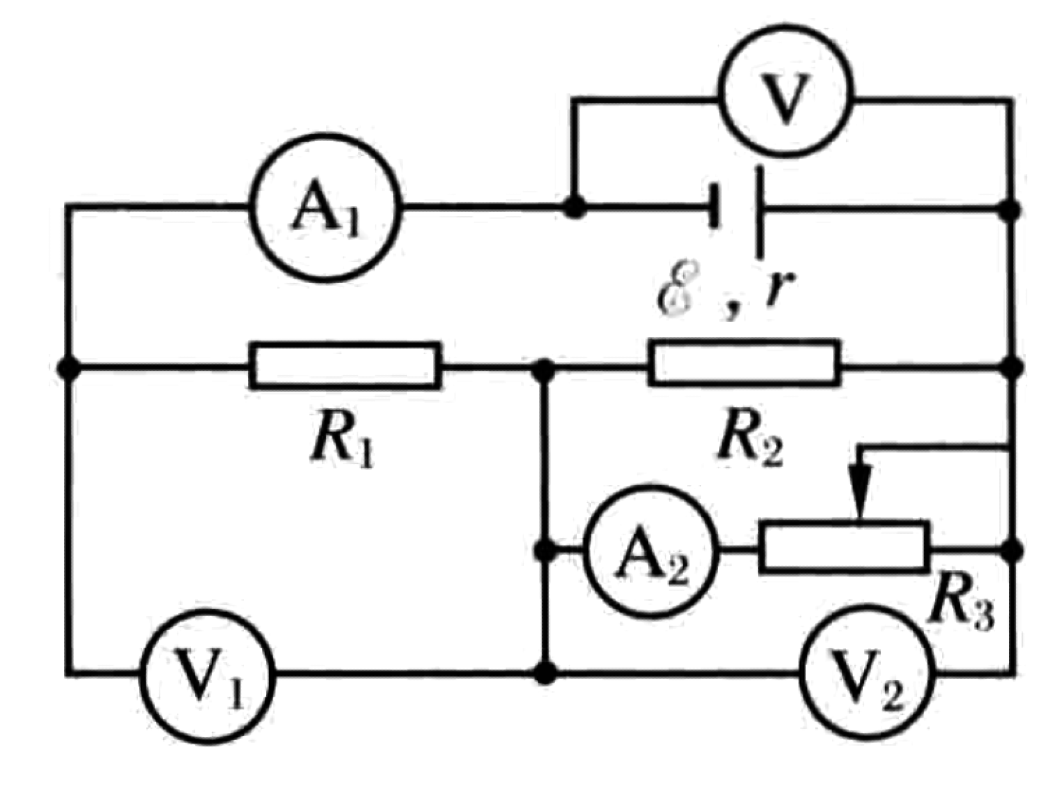
As $R_3$ decreases, the branch-2 resistance $R_2+R_3$ decreases, so the external parallel resistance $R_{\text{ext}} = \dfrac{R_1(R_2+R_3)}{R_1+R_2+R_3}$ decreases. The total current $I = \dfrac{\mathcal{E}}{R_{\text{ext}}+r}$ therefore increases, so $A_1$ rises.
Terminal voltage $U = \mathcal{E} - I r$ falls, so $V$ drops. Because $R_1$ is connected directly across the terminals, $V_1 = U$ also drops, and the branch-1 current $I_1 = U/R_1$ decreases.
By Kirchhoff's current law, the branch-2 current is $I_2 = I - I_1$. Since $I$ rises and $I_1$ falls, $I_2$ increases, so $A_2$ rises. Finally, $V_2 = U - I_2 R_2$: $U$ falls and $I_2 R_2$ grows, so $V_2$ drops.