Source: High school physics (Chinese)
Problem
In the circuit of Figure, $R_1 = 10$ $\Omega$, $R_2 = 4$ $\Omega$, $R_3 = 6$ $\Omega$, $R_4 = 3$ $\Omega$, and the source voltage is $U = 2.4$ V. The circuit topology is: the source connects between top node $T$ (positive) and ground node $G$ (negative). $R_1$ goes from $T$ down to a middle node $M$; $R_4$ goes from $M$ down to $G$. $R_2$ goes from $T$ down to node $N$, and $R_3$ goes horizontally from $M$ to $N$. Terminal $a$ is at node $N$; terminal $b$ is at $G$ (on the bottom rail).
- If a voltmeter with very high internal resistance is connected between $a$ and $b$, what does it read?
- If an ammeter with very low internal resistance is connected between $a$ and $b$, what does it read?
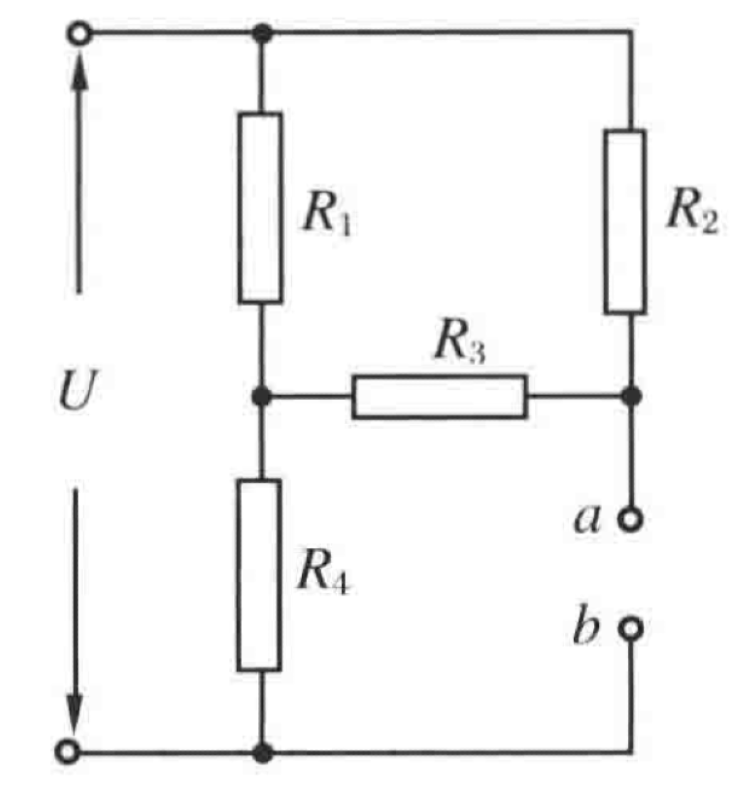
(1) Voltmeter reads $U_{ab} = 1.8$ V; \quad (2) ammeter reads $I_{ab} = 2/3 \approx 0.67$ A.
(1) Voltmeter reading. A very-high-impedance meter draws no current, so it measures the open-circuit potential $V_a - V_b$.
With no current to ground from $N$, the branch $R_2$-$R_3$ acts in series ($R_2 + R_3 = 10$ $\Omega$) and is in parallel with $R_1 = 10$ $\Omega$ between $T$ and $M$:
$$R_{TM} = R_1 \parallel (R_2 + R_3) = 10 \parallel 10 = 5 \text{ }\Omega$$Total resistance from $T$ to $G$:
$$R = R_{TM} + R_4 = 5 + 3 = 8 \text{ }\Omega, \quad I = \frac{U}{R} = \frac{2.4}{8} = 0.3 \text{ A}$$Voltage at $M$ above ground: $V_M = I R_4 = 0.9$ V, so $V_T - V_M = 1.5$ V. Current through the $R_2$-$R_3$ branch: $1.5/10 = 0.15$ A.
$$V_a = V_T - 0.15 \times R_2 = 2.4 - 0.6 = 1.8 \text{ V}$$ $$\boxed{V_{\text{voltmeter}} = U_{ab} = 1.8 \text{ V}}$$(2) Ammeter reading. A very-low-impedance meter shorts $a$ to $b$, merging $N$ with $G$.
Between $T$ and $G$ there are now two parallel paths:
- $R_2$ directly: $4$ $\Omega$
- $R_1$ in series with ($R_3 \parallel R_4$): $R_3 \parallel R_4 = 6 \parallel 3 = 2$ $\Omega$, so this path is $10 + 2 = 12$ $\Omega$
Total: $R = 4 \parallel 12 = 3$ $\Omega$. Source current $I_{\text{src}} = 2.4/3 = 0.8$ A, of which $I_{R_2} = 2.4/4 = 0.6$ A goes through $R_2$ and $I_{R_1} = 2.4/12 = 0.2$ A through the $R_1$-$R_{34}$ branch.
Then $V_M = I_{R_1} \times (R_3 \parallel R_4) = 0.2 \times 2 = 0.4$ V, giving $I_{R_3} = 0.4/6 = 1/15$ A flowing from $M$ to $N$.
By KCL at node $N$, the ammeter carries everything that arrives at $N$:
$$I_{\text{ammeter}} = I_{R_2} + I_{R_3} = 0.6 + \frac{1}{15} = \frac{10}{15} = \frac{2}{3} \approx 0.67 \text{ A}$$