Source: High school physics (Chinese)
Problem
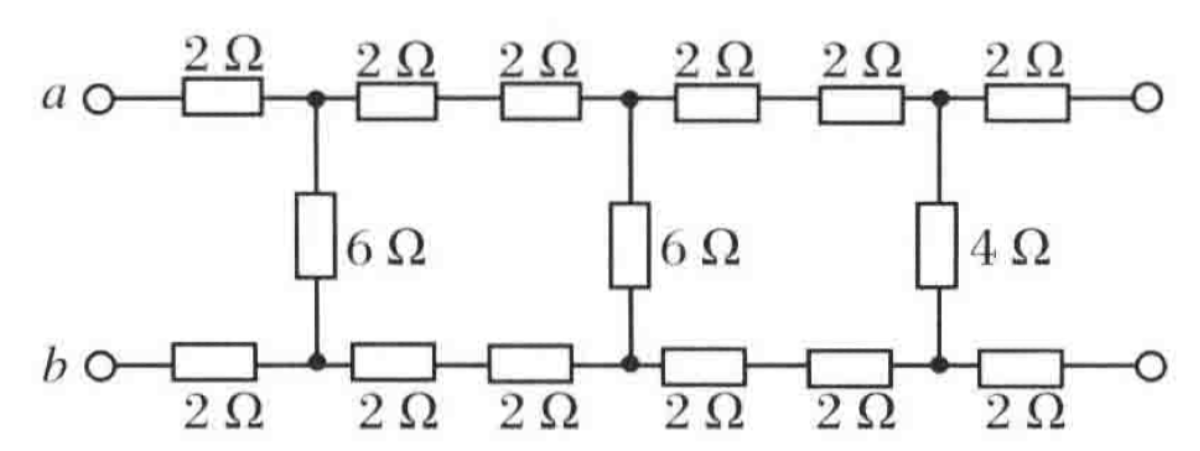
The resistor network of Figure has terminals $a$ and $b$ on the left side; its right end is open. Both the top and bottom rails consist of six $2$ $\Omega$ resistors in series. Three vertical rungs connect the rails: a $6$ $\Omega$ rung after the first resistor on each rail, a second $6$ $\Omega$ rung after the third resistor, and a $4$ $\Omega$ rung after the fifth resistor. The two $2$ $\Omega$ resistors after the last rung (one on each rail) terminate at the open right end.
- Find the equivalent resistance $R_{ab}$.
- If the current through the $4$ $\Omega$ rung is $1$ A, find the voltage $U_{ab}$.
(1) $R_{ab} = 8$ $\Omega$; \quad (2) $U_{ab} = 72$ V.
Since the right end is open, the rightmost two $2$ $\Omega$ resistors (one per rail) carry no current and can be ignored. Label the rail nodes at the rungs $A_1, A_2, A_3$ (top) and $B_1, B_2, B_3$ (bottom). Between consecutive rungs each rail contributes $2 + 2 = 4$ $\Omega$.
(1) Equivalent resistance. Work right-to-left, repeatedly combining a rung in parallel with the series path through the next stage.
At the right-most loop ($A_3$-$B_3$), the path $A_2 \to A_3 \to (\text{4 }\Omega) \to B_3 \to B_2$ has resistance $4 + 4 + 4 = 12$ $\Omega$. In parallel with the middle rung $6$ $\Omega$:
$$R_{A_2 B_2} = \frac{6 \times 12}{6 + 12} = 4 \text{ }\Omega$$Next loop: path $A_1 \to A_2 \to (R_{A_2 B_2} = 4 \text{ }\Omega) \to B_2 \to B_1$ has resistance $4 + 4 + 4 = 12$ $\Omega$. In parallel with the left rung $6$ $\Omega$:
$$R_{A_1 B_1} = \frac{6 \times 12}{6 + 12} = 4 \text{ }\Omega$$Finally, the $2$ $\Omega$ leads from $a \to A_1$ and from $B_1 \to b$ are in series:
$$R_{ab} = 2 + 4 + 2 = 8 \text{ }\Omega$$(2) Voltage with $1$ A through the $4$ $\Omega$ rung. Track currents and voltages from right to left.
Current through the rightmost loop is $1$ A, so the loop drop is $V_{A_3 B_3} = 1 \times 4 = 4$ V; the total $A_2$-to-$B_2$ drop through this loop is $4 + 4 + 4 = 12$ V.
This equals the drop across the middle $6$ $\Omega$ rung, so its current is $12/6 = 2$ A. Total current entering $A_2$ from $A_1$ (and leaving $B_2$ to $B_1$) is $1 + 2 = 3$ A.
Drop across $A_1$-to-$B_1$ via the right loops: $3 \times 4 + 12 + 3 \times 4 = 36$ V. Current through the left $6$ $\Omega$ rung: $36/6 = 6$ A. Total current entering $A_1$ from $a$ is $6 + 3 = 9$ A.
Total voltage:
$$U_{ab} = 9 \times 2 + 36 + 9 \times 2 = 72 \text{ V}$$Consistency check: $U_{ab}/R_{ab} = 72/8 = 9$ A = entering current. \checkmark