Source: High school physics (Chinese)
Problem
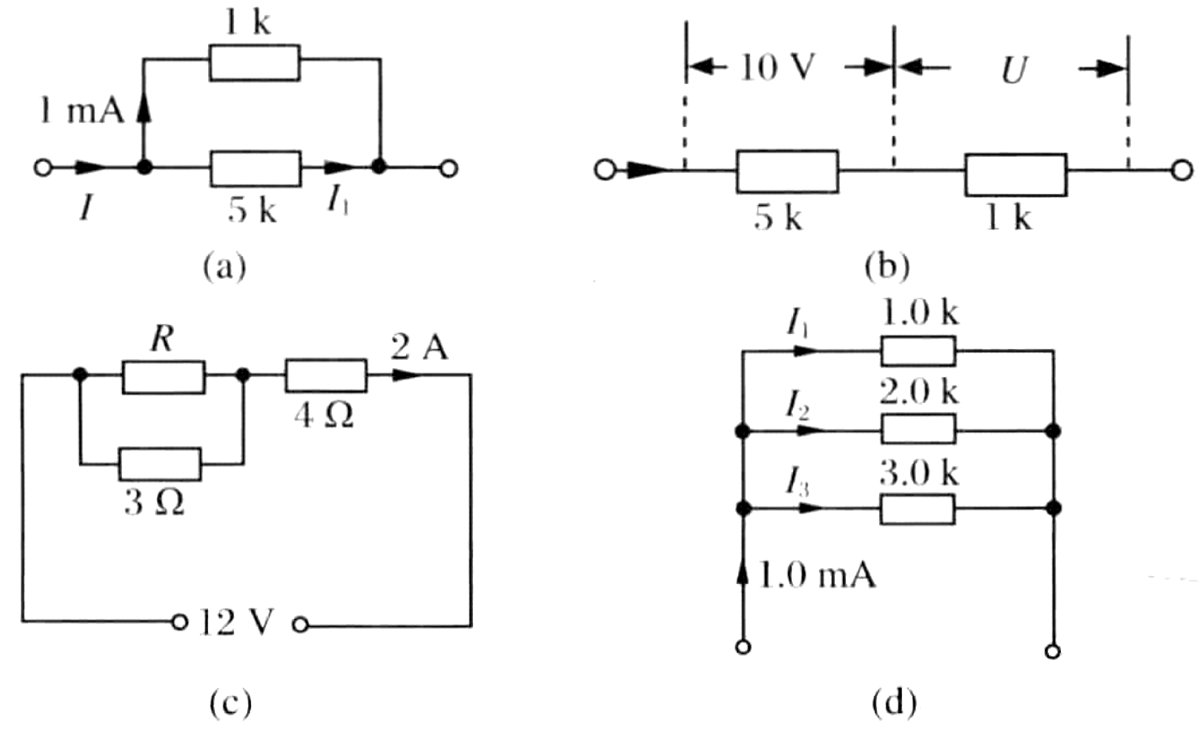
In each of the circuits of Figure, find the labeled physical quantities.
Circuit (a): A $1$ k$\Omega$ resistor and a $5$ k$\Omega$ resistor are connected in parallel between two nodes. A current of $1$ mA flows through the $1$ k$\Omega$ branch. The current $I$ enters the parallel combination from the left, and $I_1$ denotes the current through the $5$ k$\Omega$ branch.
Circuit (b): A $5$ k$\Omega$ resistor and a $1$ k$\Omega$ resistor are connected in series. The voltage across the $5$ k$\Omega$ resistor is $10$ V, and the voltage across the $1$ k$\Omega$ resistor is $U$. The current through the series circuit is $I$.
Circuit (c): Resistor $R$ is in parallel with a $3$ $\Omega$ resistor, and this parallel combination is in series with a $4$ $\Omega$ resistor. The supply voltage is $12$ V and the current through the $4$ $\Omega$ resistor is $2$ A.
Circuit (d): Three resistors of $1.0$ k$\Omega$, $2.0$ k$\Omega$, $3.0$ k$\Omega$ are connected in parallel and carry currents $I_1$, $I_2$, $I_3$ respectively. The total current entering the combination is $1.0$ mA.
- In circuit (a), find $I$ and $I_1$.
- In circuit (b), find $I$ and $U$.
- In circuit (c), find $R$.
- In circuit (d), find $I_1$, $I_2$, $I_3$.
(a) $I = 1.2$ mA, $I_1 = 0.2$ mA; \quad (b) $I = 2$ mA, $U = 2$ V; \quad (c) $R = 6$ $\Omega$; \quad (d) $I_1 \approx 0.545$ mA, $I_2 \approx 0.273$ mA, $I_3 \approx 0.182$ mA.
(1) Circuit (a). Parallel branches share the same voltage. The $1$ k$\Omega$ branch carries $1$ mA, so the common voltage is:
$$U = 1 \text{ mA} \times 1 \text{ k}\Omega = 1 \text{ V}$$Then through the $5$ k$\Omega$:
$$I_1 = \frac{1 \text{ V}}{5 \text{ k}\Omega} = 0.2 \text{ mA}$$Total current (KCL):
$$I = 1 + 0.2 = 1.2 \text{ mA}$$(2) Circuit (b). Series elements carry the same current. From the $5$ k$\Omega$ resistor:
$$I = \frac{10 \text{ V}}{5 \text{ k}\Omega} = 2 \text{ mA}$$Voltage across the $1$ k$\Omega$:
$$U = 2 \text{ mA} \times 1 \text{ k}\Omega = 2 \text{ V}$$(3) Circuit (c). The series current $2$ A flows through the $4$ $\Omega$ resistor, dropping:
$$V_4 = 2 \times 4 = 8 \text{ V}$$The remaining voltage across the parallel pair ($R \parallel 3$ $\Omega$):
$$V_p = 12 - 8 = 4 \text{ V}$$Current through the $3$ $\Omega$ resistor:
$$I_3 = \frac{4}{3} \text{ A}$$By KCL the current through $R$:
$$I_R = 2 - \frac{4}{3} = \frac{2}{3} \text{ A}$$Thus:
$$R = \frac{V_p}{I_R} = \frac{4}{2/3} = 6 \text{ }\Omega$$(4) Circuit (d). All three resistors share the same voltage $U$, and the branch currents are inversely proportional to the resistances:
$$I_1 : I_2 : I_3 = \frac{1}{1} : \frac{1}{2} : \frac{1}{3} = 6 : 3 : 2$$With total $I_1 + I_2 + I_3 = 1.0$ mA distributed in ratio $6 : 3 : 2$ (sum $11$):
$$I_1 = \frac{6}{11} \approx 0.545 \text{ mA}, \quad I_2 = \frac{3}{11} \approx 0.273 \text{ mA}, \quad I_3 = \frac{2}{11} \approx 0.182 \text{ mA}$$